Peer Review Process
Workflow and Stages of Peer Review
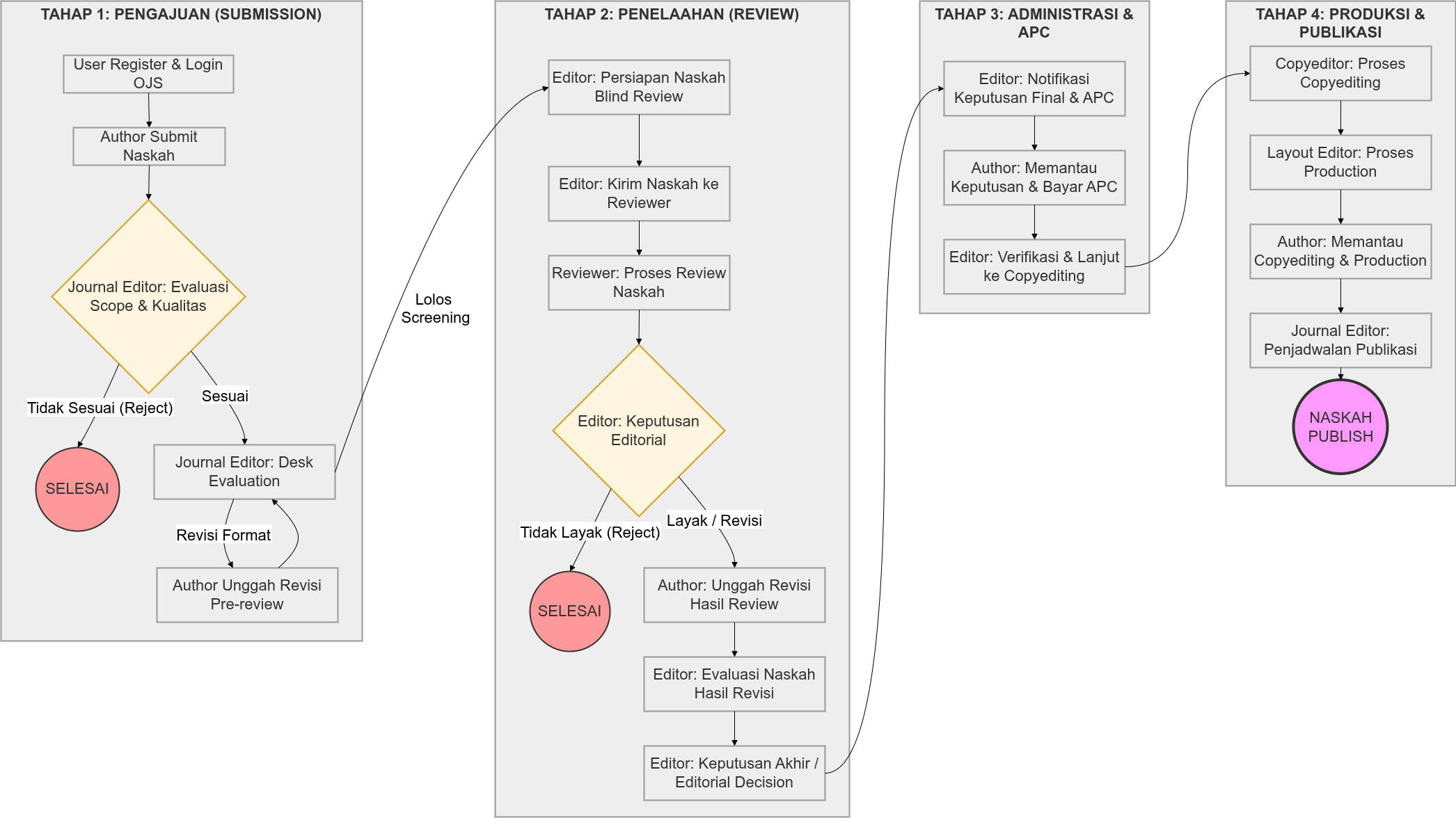
Stage 1: Submission
Initial Evaluation & Format Screening
- User Register & Login: Author registers and logs into the Open Journal Systems (OJS).
- Author Submits Manuscript: Author submits the initial manuscript.
- Scope & Quality Evaluation (Journal Editor): Journal Editor evaluates the scope and overall quality of the manuscript.
- Does not match: The manuscript is rejected (Reject → END).
- Matches: The process proceeds to the next step.
- Desk Evaluation (Journal Editor): Journal Editor conducts an initial desk evaluation and formatting check.
- Format Revision: If formatting revisions are required, the author uploads the pre-review revision, which undergoes re-evaluation.
- Passes Screening: The manuscript passes screening and moves to Stage 2.
Stage 2: Review
Double-Blind Peer Review & Editorial Decision
- Blind Review Preparation (Editor): Editor prepares the anonymized manuscript for the blind review process.
- Sends to Reviewers (Editor): Editor assigns and sends the manuscript to peer reviewers.
- Manuscript Review Process (Reviewer): Reviewers conduct an objective review of the manuscript.
- Editorial Decision (Editor): Editor makes an editorial decision based on the reviewers' feedback.
- Unsuitable: The manuscript is rejected (Reject → END).
- Eligible / Revision: The manuscript is accepted pending major or minor revisions.
- Uploads Revised Results (Author): Author uploads the revised manuscript along with a point-by-point response to reviewers.
- Evaluates Revised Manuscript (Editor): Editor evaluates the revised manuscript.
- Final Decision (Editor): Editor makes the final editorial decision and advances the manuscript to Stage 3.
Stage 3: Administration & APC
Administrative Verification & APC Payment
- Notification of Final Decision & APC (Editor): Editor sends out the official Letter of Acceptance (LoA) along with Article Processing Charge (APC) payment details.
- Monitors Decision & Pays APC (Author): Author tracks the status and completes the APC payment.
- Verify & Proceed to Copyediting (Editor): Editor verifies payment and moves the manuscript to copyediting.
Stage 4: Production & Publication
Language Editing, Layout & Publication
- Copyediting Process (Copyeditor): Copyeditor performs language, grammar, and clarity editing.
- Production Process (Layout Editor): Layout Editor creates the final PDF/HTML galley layout.
- Monitors Copyediting & Production (Author): Author tracks the production stage and performs final proofreading.
- Publication Scheduling (Journal Editor): Journal Editor schedules the article into a specific issue/volume.
- PUBLISHED MANUSCRIPT: The manuscript is officially published and assigned a DOI (Digital Object Identifier).
1. Overview and Double-Blind Peer Review Model
Jurnal Transformatika applies a Double-Blind Peer Review process to all submitted research manuscripts to ensure that published papers meet high standards of scientific quality, methodological validity, originality, and scholarly contribution to intelligent systems and informatics.
Under the double-blind peer review model:
- The identities of the authors are concealed from the peer reviewers throughout the evaluation process.
- The identities of the peer reviewers remain strictly confidential and are concealed from the authors.
While the editorial board facilitates and monitors the progress of the review to ensure quality and timeliness, the integrity and independence of the peer-review process are strictly maintained.
2. Initial Editorial Assessment & Desk Screening
Before being sent to external reviewers, all submitted manuscripts undergo an initial editorial assessment by the handling editor:
- Scope & Relevance Check: Verification that the manuscript aligns with the focus and scope of Jurnal Transformatika.
- Format & Template Compliance: Screening for adherence to submission guidelines, author guidelines, and official manuscript templates.
- Plagiarism & Similarity Screening: An initial similarity assessment (e.g., via Turnitin) is conducted using the document "Statement of Originality" to identify potential plagiarism or substantial text overlap with previously published works.
Manuscripts that do not meet the journal's basic requirements or fall outside its scope may be rejected without external peer review (Desk Reject). Submissions considered suitable proceed to the peer review stage.
3. Peer Review Evaluation Criteria
Suitable submissions are assigned to at least two (2) independent experts with relevant subject expertise. Reviewers conduct an objective evaluation of the manuscript based on the following key aspects:
- Originality and Novelty: Clear contribution of new algorithms, architectures, or empirical findings.
- Relevance: Alignment with the aims and scope of Jurnal Transformatika.
- Scientific Soundness & Rigor: Methodological correctness, logical coherence, and analytical validity.
- Clarity and Presentation: Organization, readability, proper structure, and adherence to IEEE citation standards.
- Appropriateness of Research Methods: Validity of experimental setups, data collection, and supporting arguments.
- Contribution to Domain: Practical and theoretical impact on intelligent systems and informatics scholarship.
- Plagiarism & Duplication Screening: Identification of potential duplication, text recycling, or uncredited sources.
Reviewers provide constructive feedback and recommendations to assist the editorial decision.
4. Categorization of Editorial Decisions
Editorial decisions are made based on the reviewer reports and editorial evaluation. The Editor-in-Chief or Handling Editor will issue one of four official decisions:
- Accepted: The manuscript is accepted for publication, subject to necessary production and layout adjustments.
- Minor Revision: Limited corrections, formatting adjustments, or minor clarifications are required before final acceptance.
- Major Revision: Substantial revisions regarding methodology, experiments, or analysis are required. The revised manuscript will undergo a second round of peer review.
- Rejected: The manuscript contains fatal flaws, lacks sufficient novelty, or fails to meet the academic standards of the journal.
Note: Authors must carefully address all reviewer comments in a point-by-point response document when submitting revisions. Submission of a revised manuscript does not guarantee acceptance.
5. Estimated Timeline for the Editorial & Publication Workflow
The estimated duration of each stage in the OJS publication workflow is outlined below:
| Stage | Workflow Activity | Key Tasks & Responsibilities | Estimated Duration |
|---|---|---|---|
| 1. Initial Assessment | Submission & Desk Screening | Scope evaluation, template check, and Turnitin similarity screening. | 1 – 2 Weeks |
| 2. Author Pre-Review Revision | Formatting Adjustments | Preliminary formatting or template corrections requested by the editor. | 1 Week |
| 3. Peer Review Stage | Double-Blind Review | Anonymized review conducted by at least two independent peer reviewers. | Target: 4–8 Weeks (Up to 16 Weeks) |
| 4. Revision Following Review | Author Revisions | Author addresses reviewer feedback and uploads the revised manuscript with a response document. | 2 Weeks |
| 5. Re-evaluation & Final Decision | Editorial Evaluation | Handling Editor evaluates revised manuscript and issues final LoA or second review. | 1 – 2 Weeks |
| 6. Administration & APC | APC Verification | Author completes Article Processing Charge payment upon acceptance. | 1 Week |
| 7. Copyediting & Production | Copyediting & Galley Proof | Language editing, PDF layout creation, and final author proofreading. | 2 Weeks |
| 8. Official Publication | Issue Scheduling & DOI | Final scheduling into an issue and assignment of persistent DOI. | 1 Week |
6. Review Period and Timeline Disclaimer
- Target Review Period: The review phase typically requires a minimum of 4 weeks and targets completion within 2 months .
- Potential Delays: The review process may extend up to 4 months due to high submission volume, reviewer availability, or complex revision rounds.
- Timeline Disclaimer: All stated durations are estimates and do not represent guaranteed deadlines. Total processing time depends on manuscript quality, author responsiveness, and editorial workload.
7. Editorial Authority & Ethical Safeguards
- Final Editorial Authority: The Editor-in-Chief retains full authority over all final publication decisions, which are made independently based on peer review reports, academic quality, and editorial policies.
- Prohibition of Fast-Track / Acceptance Fees: Jurnal Transformatika strictly prohibits any paid "fast-track" review scheme that promises or guarantees publication. APCs apply only after formal acceptance and never influence editorial outcomes.
- Prohibition of Generative AI Usage by Reviewers: Reviewers are strictly prohibited from uploading, pasting, or processing submitted manuscripts into external generative AI platforms (e.g., ChatGPT, Claude) to protect author copyright, confidentiality, and intellectual property.