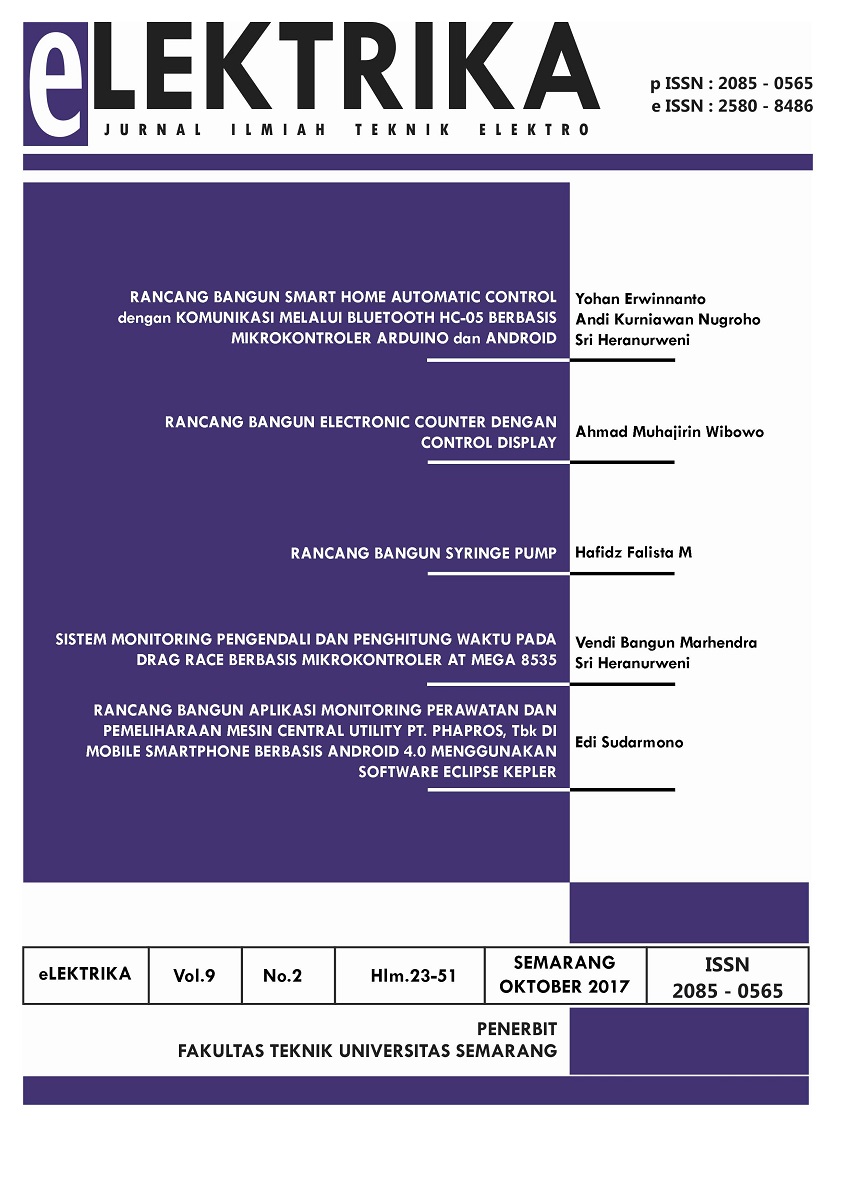
SISTEM MONITORING PENGENDALI DAN PENGHITUNG WAKTU PADA DRAG RACE BERBASIS MIKROKONTROLER AT MEGA 8535
DOI:
https://doi.org/10.26623/elektrika.v9i2.1095Keywords:
Atmega 8535 microcontroller, jump start, stopwatchAbstract
In a drag race, which is often held by race organizers. The process of determining the jump start and determining who crosses the first finish line still relies on human monitoring. Manually recording (stopwatch) is not enough because there are many inhibiting factors, including: operator, start theft by drivers, recording results, damage to the stopwatch and others. The drag race is often held during the day. The hot weather will cause someone to get tired quickly, in this case it is aimed at the person who is the operator who monitors the theft of the start and the operator at the finish line because the person is in the middle of a very hot track. Based on the reasons mentioned above, it is necessary to have a controller and timer system on the ATMega8535 microcontrollerbased drag race. Making this tool will facilitate the work of humans in obtaining information in the racing arena that does not allow humans to do it manually, so that accurate data is obtained.
Keywords: Atmega 8535 microcontroller, jump start, stopwatch
References
Anonim, 2004, RS-232 Driver Module, http://www.HVWTech.com, Canada. 2. Bishop, O., 2004, Dasar - dasar Elektronika, Penerbit PT. Gelora Aksara Pratama, Jakarta. 3. Endra Pitowarno, Robotika, ANDI Offset, Yogyakarta, 2006. 4. 4.Frank D. Petruzella, Industrial Electronics, Mc Graw Hill, Singapura, 1996. 5. Lingga Wardana, 2006, Belajar Sendiri Mikrokontroler AVR Seri ATMega8535 Simulasi,Hardwear, dan Aplikasi 6. Malvino, P.A., 1996, Prinsip - prinsip Elektronika, Penerbit Erlangga, Jakarta.
Nalwan, P. A., 2003, Panduan Praktis Teknik Antarmuka dan Pemrograman Mikrokontroler AT89C51, PT Elex Media Komputindo, Jakarta. 8. Petruzella, F. D., 1996, Elektronik Industri, Diterjemahkan oleh: Sumanto, Penerbit Andi, Yogyakarta. 9. Sutrisno, 1990, Rangkaian Digital dan Rancangan Logika, Penerbit Erlangga,
Published
Issue
Section
License
Authors who publish this journal agree to the following terms:
The author owns the copyright and grants the journal the first publication rights with the work simultaneously licensed under the Creative Commons Attribution 4.0 International License which allows others to share the work with recognition of the authorship of the work and initial publication in the journal.
Authors may enter into separate additional contractual agreements for non-exclusive distribution of the published journal version of the work (e.g., posting it to an institutional repository or publishing it in a book), in recognition of its initial publication in this journal.
Authors are allowed and encouraged to post their work online (e.g., in institutional repositories or on their websites) before and during the submission process, as it can lead to productive exchanges, as well as earlier and larger citations of published works (See The Effects of Open Access).

This work is licensed under the Creative Commons Attribution 4.0 International License.