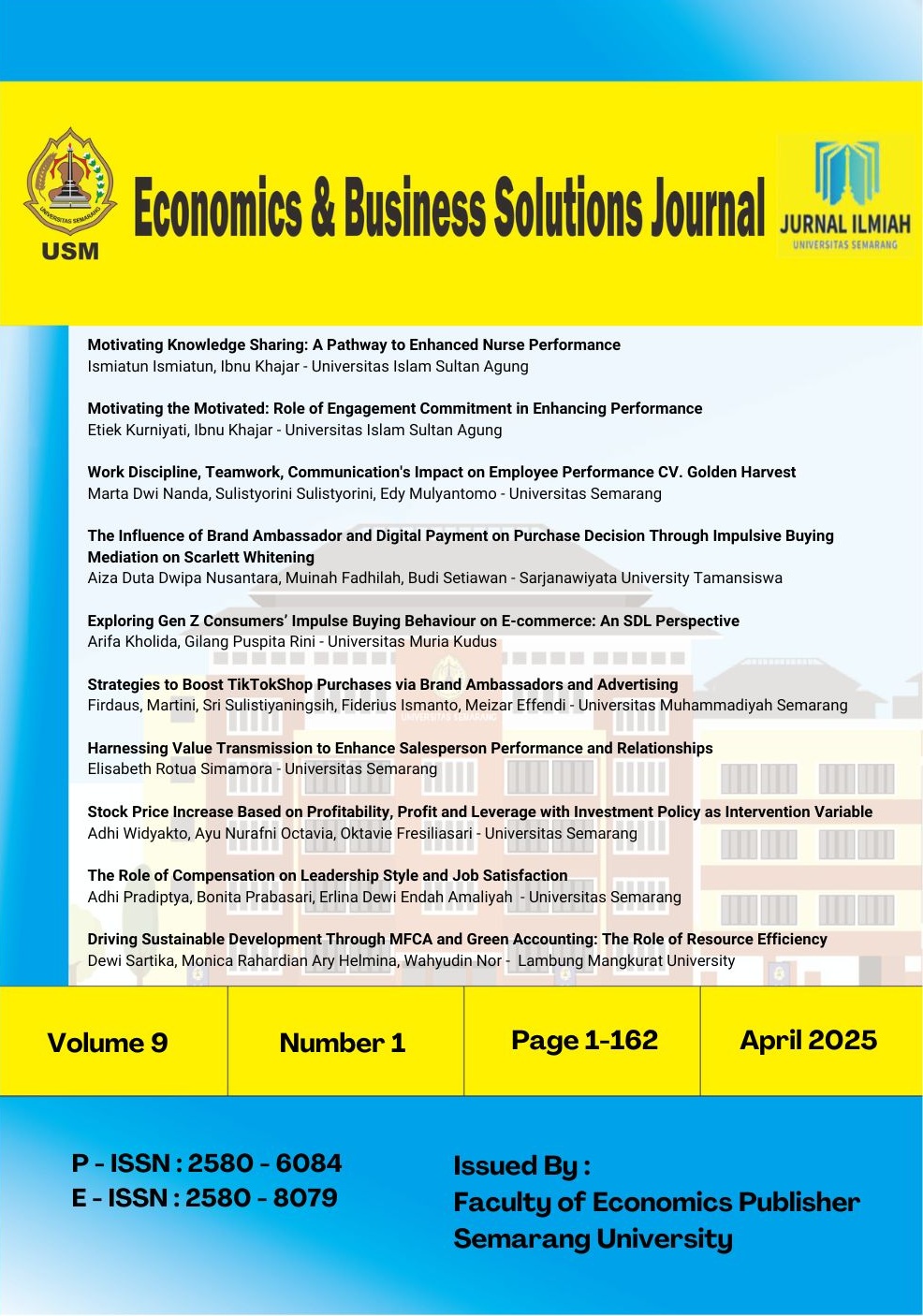
Driving Sustainable Development Through MFCA and Green Accounting: The Role of Resource Efficiency 549 329
DOI:
https://doi.org/10.26623/ebsj.v9i1.11917Keywords:
Material Flow Cost Accounting , Green Accounting , Sustainable Development, Resource EfficiencyAbstract
This study aims to analyze the influence of Material Flow Cost Accounting (MFCA) and Green Accounting on Sustainable Development, with Resource Efficiency as a moderating variable. The independent variables in this study are Material Flow Cost Accounting and Green Accounting, while the dependent variable is Sustainable Development. Resource Efficiency serves as the moderating variable. The population in this study consists of employees working in consumer non-cyclical companies listed on the Indonesia Stock Exchange (IDX). The sample was selected using a simple random sampling technique, with a total of 84 respondents. Data were analyzed using the Structural Equation Modeling–Partial Least Squares (SEM-PLS) method. The results show that Material Flow Cost Accounting and Green Accounting have a significant influence on Sustainable Development. Furthermore, Resource Efficiency strengthens the relationship between MFCA and Green Accounting with Sustainable Development
References
Alhumoudi, H., Alakkas, A. A., Khan, S., Imam, A., Baig, A., Omer, A. M., & Khan, I. A. (2024). Carbon Management Accounting Considerations for Corporate Carbon Reduction: The Limitations and Future of Integrating Life Cycle Assessment and Material Flow Cost Accounting. International Journal of Sustainable Development & Planning, 19(5).
Angelin, N., & Ulfah, Y. (2024). The Effect of Material Flow Cost Accounting on Company Sustainability: Moderating Role of Green Accounting in Consumer Goods Industry Companies. Humanities, 3(1), 27-43.Cohen, J. R. (2009). The Supply of Corporate Social Responsibility Disclosures among U.S.
Deegan, C. (2002). The Legitimising Effect of Social and Environmental Disclosure. Accounting, Auditing, and Accountability Journal, Vol.5 No.3: 282-311.
Dimitrov, K. (2024). Improving Compliance and Transparency In Financial Reporting: Strategies For Promoting Accountability and Integrity In Corporate Practices. In Сборник доклади от научна конференция „Знание, наука, иновации, технологии” (Vol. 1, No. 4, pp. 364-376). Институт за знание, наука и иновации ЕООД.
Dinar. (2016). Pengaruh Biaya Produksi dan Biya Promosi terhadap Penjualan Ud Tirta di Jembrana.
Dwianika, A., Purwanto, E., Suyoto, Y. T., & Pitaloka, E. (2024). Bibliometrics analysis of green accounting research. International Journal of Energy Economics and Policy, 14(1), 349-358.Lako, P. D. (2018). Akuntansi Hijau. Jakarta: Salemba Empat.
Egbert, J., & Plonsky, L. (2021). Bootstrapping techniques. In A practical handbook of corpus linguistics (pp. 593-610). Cham: Springer International Publishing.
Favi, C., Marconi, M., Mandolini, M., & Germani, M. (2022). Sustainable life cycle and energy management of discrete manufacturing plants in the industry 4.0 framework. Applied Energy, 312, 118671.
Fitriani, D., & Pandin, M. (2025). Analisis Penerapan Green Accounting dan Green Economy terhadap Ketahanan Keuangan Perusahaan Sektor Manufaktur. Jurnal Ekonomi, Manajemen, Akuntansi dan Keuangan, 6(1), 12-12.
Gao, J. Q., Li, D., Qiao, G. H., Jia, Q. R., Li, S. R., & Gao, H. L. (2024). Circular economy strategies in supply chains, enhancing resource efficiency and sustainable development goals. Environmental Science and Pollution Research, 31(6), 8751-8767.
Ghozali, I. (2016). Aplikasi Analisis Multivariete Dengan Program IBM SPSS 23 (Edisi 8). Semarang.
Greenpeace, I. (2018). Survei Global Mengungkap Kontribusi Perusahaan FMCG Terhadap Krisis Polusi Plastik di Masa Depan. From Greenpeace Indonesia: https://www.greenpeace.org/indonesia/siaranpers/1749/survei-global-mengungkap-kontribusi-perusahaan-fmcgterhadap-krisis-polusi-plastik-di-masa-depan/
Haykal, I. (2021, April 16). Indonesia Darurat Sampah Plastik. From Berita Jatim: https://beritajatim.com/postingan-anda/indonesia-darurat-sampahplastik/
Helmina, M. R. A., Yusniar, M. W., & Respati, N. W. (2025). Green development and its impact on financial performance and corporate value in the coal industry. Multidisciplinary Science Journal, 7(5), 2025255-2025255.
Helmina, M. R. A., Sutomo, I., & Respati, N. W. (2022). Empirical Examination of Green Industry Strategy through ISO-14001 on Firm Value: Mediating Roles of Profitability and Leverage. Planning, 17(5), 1417-1424.Hernadi, B. H. (2012). Green Accounting for Corporate Sustainability. Economics Journal.
Idris. (2012). Akuntansi Lingkungan Sebagai Instrumen Pengungkapan Tanggung Jawab Perusahaan Terhadap Lingkungan di Era Green Market.
Lindawati, A. L. (2015). Corporate Social Responsibility: Implikasi Stakeholder dan Legitimacy Gap Dalam Peningkatan Kinerja Perusahaan.
Loen, M. (2018). Penerapan Green Accounting Dan Material Flow Cost Accounting (Mfca) Terhadap Sustainable Development.
Luo, L. Q. (2013). Comparison of Propensity for Carbon Disclosure between Developing and Developend Countries: A Resource Constraint Perspektif.
M. Wahyuddin Abdullah, H. A. (2020). Efek Green Accounting Terhadap Material Flow Cost Accounting Dalam Meningkatkan Keberlangsungan Perusahaan.
Marota, R. (2017). Green Concepts and Material Flow Cost Accounting, Application For Company Sustainability.
(UNEP), U. N. (2010). United Nations Environment Programme.
Downloads
Published
Issue
Section
License
Copyright (c) 2025 Dewi Sartika, Monica Rahardian Ary Helmina, Wahyudin Nor

This work is licensed under a Creative Commons Attribution 4.0 International License.
The journal holds the copyright for each article published with work licensed simultaneously under a Creative Commons Attribution 4.0 International License, which allows others to share the work with an acknowledgment of the authorship and early publication of the work in this journal.








 This work is licensed under a