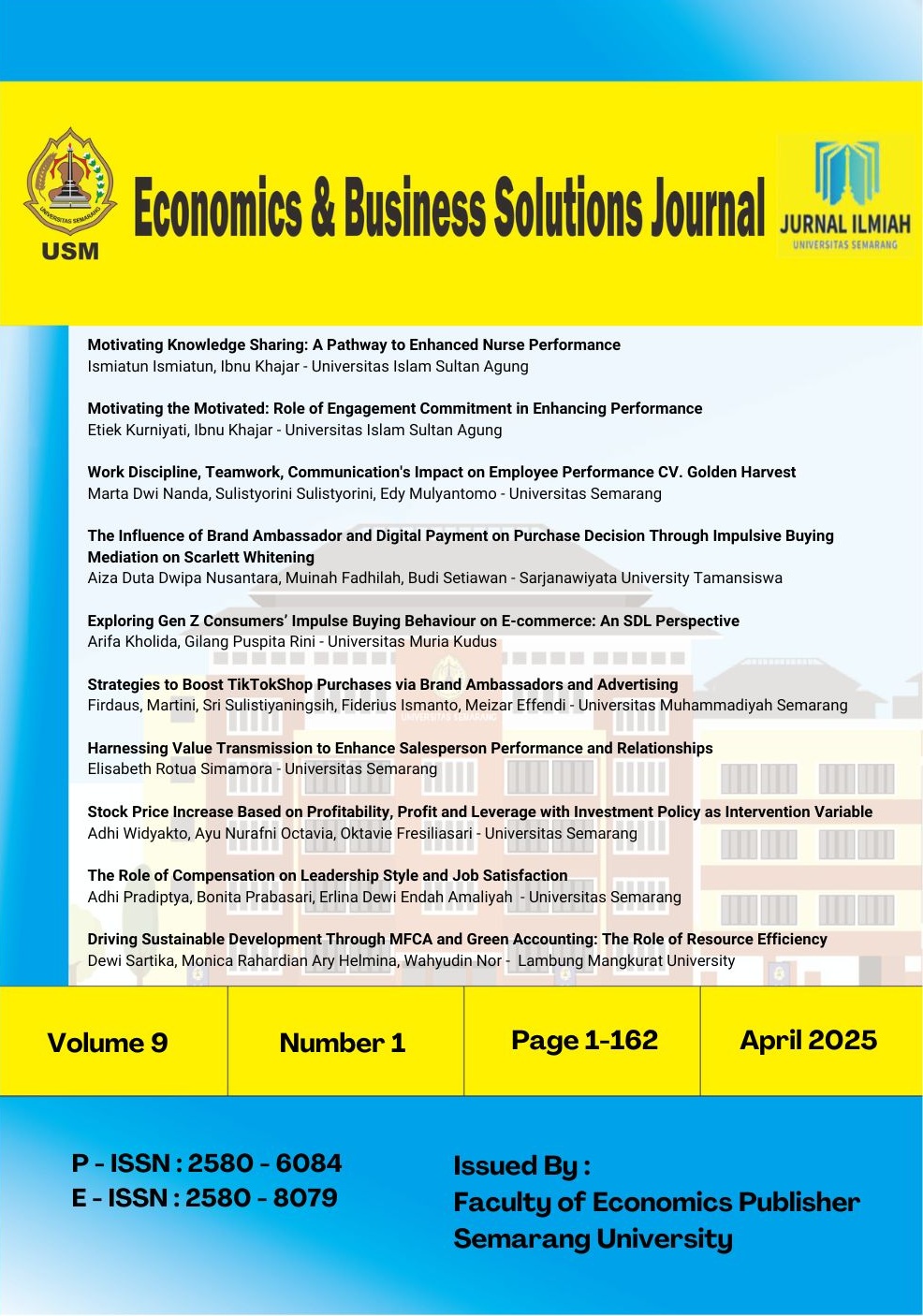
Harnessing Value Transmission to Enhance Salesperson Performance and Relationships 358 226
DOI:
https://doi.org/10.26623/ebsj.v9i1.11882Keywords:
Relational Capability, Value Transmission Effectiveness, Sales Person Performance, Service Dominant LogicAbstract
The company capable of winning the competition is the company that becomes the choice for the customers. The success of a company in getting a reference on a customer's mind, thus resulting in purchasing actions carried out by customers must be distinct from the company's efforts to know what its priorities on customer desires and give them the best of their needs. One thing that supports this company's success is the management of the sales force. In improving sales force performance, each sales force must have expertise on adapting by digging information about the needs of buyers, own cognitive intelligence and knowledge of product goods. This research highlights the contradictory relationship between relational capabilities on performance power sales. The objective of this study is to analyze variable Value Transmission Effectiveness, which are expected to resolve the contradiction between relational capability and sales performance. A distribution sample was given to Power Seller Pharmacy using a purposive sampling technique. The testing model and hypothesis use an equality analysis model (Structural Equation Model-SEM) with AMOS software
References
Boehnke, K. (2016). Parent-Offspring Value Transmission in a Societal Context. Journal of Cross-Cultural Psychology, 32(2), 241-255. doi:10.1177/0022022101032002010
Bordian, M., Gil-Saura, I., & Šerić, M. (2023). The impact of value co-creation in sustainable services: understanding generational differences. Journal of Services Marketing, 37(2), 155-167. doi:10.1108/JSM-06-2021-0234
Boukis, A., & Kabadayi, S. (2020). A classification of resources for employee-based value creation and a future research agenda. European Management Journal, 38(6), 863-873. doi:10.1016/j.emj.2020.05.001
Busser, J. A., & Shulga, L. V. (2018). Co-created value: Multidimensional scale and nomological network. Tourism Management, 65, 69-86. doi:10.1016/j.tourman.2017.09.014
Chatterjee, S., Chaudhuri, R., Vrontis, D., Thrassou, A., Ghosh, S. K., & Chaudhuri, S. (2021). Social customer relationship management factors and business benefits. International Journal of Organizational Analysis, 29(1), 35-58.
Chawla, V., Lyngdoh, T., Guda, S., & Purani, K. (2020). Systematic review of determinants of sales performance: Verbeke et al.’s (2011) classification extended. Journal of Business Industrial Marketing Management, 35(8), 1359-1383.
Duan, J., Wang, X.-H., Janssen, O., & Farh, J.-L. (2022). Transformational leadership and voice: when does felt obligation to the leader matter? Journal of Business Psychology, 1-13.
Duan, W., Tang, X., Li, Y., Cheng, X., & Zhang, H. J. C. R. J. (2020). Perceived organizational support and employee creativity: The mediation role of calling. 32(4), 403-411.
Feng, T., Wang, D., Lawton, A., & Luo, B. N. (2019). Customer orientation and firm performance: The joint moderating effects of ethical leadership and competitive intensity. Journal of Business Research, 100, 111-121.
Ferdinand, A. T., & Wahyuningsih, W. (2018). Salespeople’s innovativeness: a driver of sales performance. Management & Marketing, 13(2), 966-984. doi:10.2478/mmcks-2018-0016
Gazi, M. A. I., Al Mamun, A., Al Masud, A., Senathirajah, A. R. b. S., & Rahman, T. (2024). The relationship between CRM, knowledge management, organization commitment, customer profitability and customer loyalty in telecommunication industry: The mediating role of customer satisfaction and the moderating role of brand image. Journal of Open Innovation: Technology, Market, Complexity, 10(1), 100227.
Gupta, P., Sachan, A., & Kumar, R. (2020). Different stages of the e-service delivery system process: belief–attitude–intention framework. International Journal of Retail Distribution Management, 48(7), 687-706.
Hapsari, R. M., Indriani, F., & Sutopo, S. (2017). QUALITY ANALYSIS OF SUPPORT MARKETING AND QUALITY OF SALES TRAINING ON SALES PERFORMANCE CAPABILITY ON PERFORMANCE SALES PERFORMANCE. Jurnal Sains Pemasaran Indonesia, 16(3), 145-166.
Indriastuti, H. (2019). Entrepreneurial inattentiveness, relational capabilities and value co-creation to enhance marketing performance. Humanities Social Sciences Reviews, 7(3), 181-188.
Ivanova-Gongne, M., Torkkeli, L., Hannibal, M., Uzhegova, M., Barner-Rasmussen, W., Dziubaniuk, O., & Kulkov, I. (2022). Cultural sensemaking of corporate social responsibility: A dyadic view of Russian–Finnish business relationships. Industrial Marketing Management, 101, 153-164.
Kaski, T., Niemi, J., & Pullins, E. (2018). Rapport building in authentic B2B sales interaction. Industrial Marketing Management, 69, 235-252. doi:10.1016/j.indmarman.2017.08.019
Key, T. M., & Keel, A. L. (2020). How executives talk: Exploring marketing executive value articulation with computerized text analysis. European Journal of Marketing, 54(3), 546-569.
Khan, R. U., Salamzadeh, Y., Iqbal, Q., & Yang, S. (2022). The impact of customer relationship management and company reputation on customer loyalty: The mediating role of customer satisfaction. Journal of Relationship Marketing, 21(1), 1-26.
Liu, Y., & Zhao, X. (2021). Successful implementation of value-based selling: a value co-creation and dynamic capabilities perspective. Journal of Business Industrial Marketing Management, 36(3), 372-389.
Malik, F., Wang, F., Naseem, M. A., Ikram, A., & Ali, S. (2020). Determinants of Corporate Social Responsibility Related to CEO Attributes: An Empirical Study. SAGE Open, 10(1). doi:10.1177/2158244019899093
Mitrega, M., Henneberg, S. C., & Forkmann, S. (2018). Capabilities in business relationships and networks: An introduction to the special issue. Industrial Marketing Management, 74, 1-3. doi:10.1016/j.indmarman.2018.07.006
Nyamrunda, F. C., & Freeman, S. (2021). Strategic agility, dynamic relational capability and trust among SMEs in transitional economies. Journal of World Business, 56(3), 101175.
Otero, I., Salgado, J. F., & Moscoso, S. (2022). Cognitive reflection, cognitive intelligence, and cognitive abilities: A meta-analysis. Intelligence, 90, 101614.
Rintamäki, T., & Saarijärvi, H. (2021). An integrative framework for managing customer value propositions. Journal of Business Research, 134, 754-764.
Sánchez-Gutiérrez, J., Cabanelas, P., Lampón, J. F., & González-Alvarado, T. E. (2019). The impact on competitiveness of customer value creation through relationship capabilities and marketing innovation. Journal of Business Industrial Marketing Management, 34(3), 618-627.
Sarstedt, M., Hair, J. F., Ringle, C. M., Thiele, K. O., & Gudergan, S. P. (2016). Estimation issues with PLS and CBSEM: Where the bias lies! Journal of Business Research, 69(10), 3998-4010. doi:10.1016/j.jbusres.2016.06.007
Setiawan, M. B. (2018). Mediating effect of value creation in the relationship between relational capabilities on business performance. Contaduría y Administración, 63, 1-21.
Shehata, G. M. (2020). Exploiting market-oriented collective learning cycle to leverage competitive advantage at a foreign subsidiary in emerging markets. European Business Review, 32(1), 86-128. doi:10.1108/ebr-03-2018-0063
Shulga, L. V., & Busser, J. A. (2020). Hospitality employee and customer role in value co-creation: Personal, organizational and collaborative outcomes. International Journal of Hospitality Management, 91. doi:10.1016/j.ijhm.2020.102648
Singh, R., Charan, P., Chattopadhyay, M., & Organization. (2022). Effect of relational capability on dynamic capability: exploring the role of competitive intensity and environmental uncertainty. Journal of Management, 28(3), 659-680.
Smirnova, M., Naudé, P., Henneberg, S. C., Mouzas, S., & Kouchtch, S. P. (2011). The impact of market orientation on the development of relational capabilities and performance outcomes: The case of Russian industrial firms. Industrial Marketing Management, 40(1), 44-53.
Varadarajan, R. (2020). Customer information resources advantage, marketing strategy and business performance: A market resources based view. Industrial Marketing Management, 89, 89-97.
Vargo, S. L., & Lusch, R. F. (2017). Service-dominant logic 2025. International Journal of Research in Marketing, 34(1), 46-67. doi:10.1016/j.ijresmar.2016.11.001
Viio, P., & Grönroos, C. (2016). How buyer–seller relationship orientation affects adaptation of sales processes to the buying process. Industrial Marketing Management, 52, 37-46.
Downloads
Published
Issue
Section
License
Copyright (c) 2025 Elisabeth Rotua Simamora

This work is licensed under a Creative Commons Attribution 4.0 International License.
The journal holds the copyright for each article published with work licensed simultaneously under a Creative Commons Attribution 4.0 International License, which allows others to share the work with an acknowledgment of the authorship and early publication of the work in this journal.










 This work is licensed under a