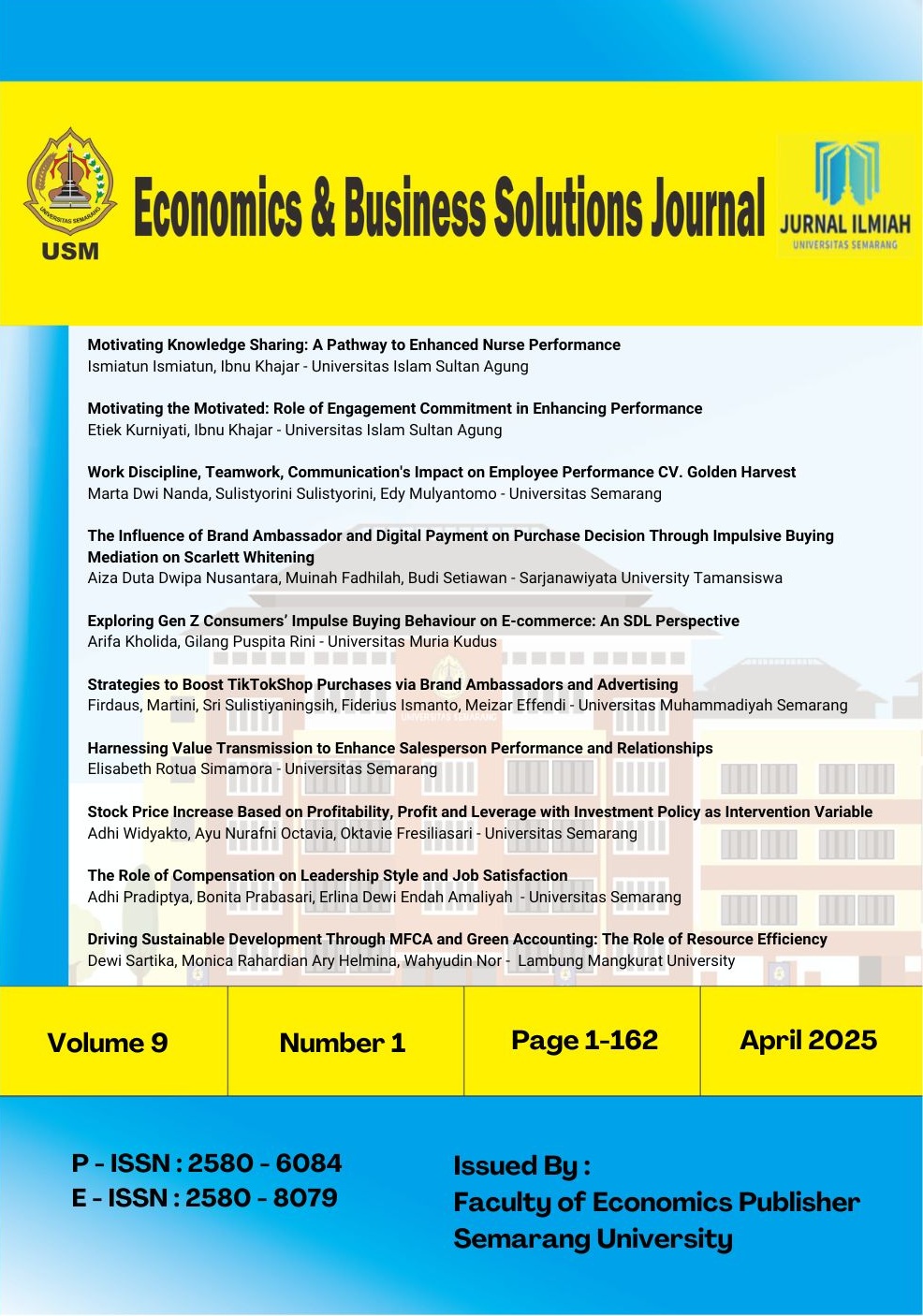
Motivating Knowledge Sharing: A Pathway to Enhanced Nurse Performance 372 251
DOI:
https://doi.org/10.26623/ebsj.v9i1.11105Keywords:
job satisfaction, knowledge sharing, performance, human resource management, organizational effectivenessAbstract
This study investigated the influence of work motivation and knowleldge sharing on employee performance within the healthcare sector, specifically among nursing staff at RSUD dr Gondo Suwarno. The research aimed to explore the direct and indirect effects of these variables, with job satisfaction serving as a mediating factor. Data was collected through a quantitative survey involving 149 nursing staff, and structural equation modeling (SEM) was employes to analyze the relationships. The findings revaled that work motivation did directly impact employee performance, and it positively influenced job satisfaction. Conversely, knowledge sharing demonstrated a significant positive relationship with both job satisfaction and employee performance. Moreover, job satisfaction emerged as a crucial mediator, amplifying the positive effects of both work motivation and knowledge sharing on employee performance. These reseults underscore the importance of holostic human resource management strategies that prioritize employee satisfaction. Organixation are encouraged to create supportive work environments that foster motivation, facilitate knowledge sharing, and offer opportunities for career development. Future research could delve deeper into the dynamic of these relationships within diverse organizational contexts
References
Afshari, L., Ahmad, M. S., & Mansoor, T. (2024). How to lead responsibly toward enhanced knowledge sharing behavior and performance: implications for human resource management. Personnel Review, 53(4), 944–964. https://doi.org/10.1108/PR-12-2022-0869
Agnes, M. (2010). Analisis Pengaruh Kepuasan Pelanggan. Analisis Pengaruh Kepuasan Pelanggan, 35–55.
Bartol, K. M., & Srivastava, A. (2002). Encouraging Knowledge Sharing: The Role of Organizational Reward Systems. Journal of Leadership & Organizational Studies, 9(1), 64–76. https://doi.org/10.1177/107179190200900105
Bock, G. W., Kankanhalli, A., & Sharma, S. (2006). Are norms enough? the role of collaborative norms in promoting organizational knowledge seeking. European Journal of Information Systems, 15(4), 357–367. https://doi.org/10.1057/palgrave.ejis.3000630
Bock, G. W., Mahmood, M., Sharma, S., & Kang, Y. J. (2010). The impact of information overload and contribution overload on continued usage of electronic knowledge repositories. Journal of Organizational Computing and Electronic Commerce, 20(3), 257–278. https://doi.org/10.1080/10919392.2010.494530
Evita, S. N., Muizu, W. O. Z., & Raden Tri Wayu Atmojo. (2019). Penilaian Kinerja Karyawan Dengan Menggunakan Metode Behaviorally Anchor Rating Scale dan Management By Objectives (Studi kasus pada PT Qwords Company International). Pekbis Jurnal, 9(1), 18–32.
George, J. M., & Jones, G. R. (2005). Understanding and Managing Organizational Behavior. Pearson Prentice Hall. https://books.google.co.id/books?id=6zhEAAAAYAAJ
George, J. M., & Jones, G. R. (2012). Understanding and Managing Organizational Behavior (Six). Prentice Hall.
Ghozali, I., & Latan, H. (2015). Partial Least Squares, konsep, teknik dan aplikasi menggunakan program Smartpls 3.0 untuk penelitian empiris. Badan Penerbit Universitas Diponegoro.
Hoegl, M., Parboteeah, K. P., & Munson, C. L. (2003). Team-Level Antecedents of Individuals’ Knowledge Networks. Decision Sciences, 34(4), 741–770. https://doi.org/https://doi.org/10.1111/j.1540-5414.2003.02344.x
Ivancevich, J., Konopaske, R., & Matteson, M. T. (2008). Perilaku dan Manajemen Organisasi (Jilid 1 da). Erlangga.
Koontz, H., & Weihrich, H. (2007). Essentials of management: an international perspective (7th ed). Tata McGraw-Hill. https://doi.org/LK - https://worldcat.org/title/251663251
Lusri, L., & Siagian, H. (2017). Pengaruh motivasi kerja terhadap kinerja karyawan melalui kepuasan kerja sebagai variabel mediasi pada karyawan PT. Borwita citra prima Surabaya. Agora, 5(1), 1–8. https://media.neliti.com/media/publications/54167-ID-pengaruh-motivasi-kerja-terhadap-kinerja.pdf
Luthans, F. (2011). Organizational behavior: an evidence-based approach (12th ed). McGraw-Hill Irwin. https://doi.org/LK - https://worldcat.org/title/436028022
Maulana, R., & Syukri, A. (2023). Pengaruh Motivasi Kerja dan Disiplin Kerja Terhadap Kinerja Karyawan Pada PT. Penta Artha Impressi Jakarta Selatan. Jurnal Ilmiah Swara MaNajemen (Swara Mahasiswa Manajemen), 3(1), 104. https://doi.org/10.32493/jism.v3i1.29060
McShane, S., Von Glinow, M. A., & Sharma, R. (2011). Organizational Behavior (5th Editio).
Munandar, U. (2012). Pengembangan Kreativitas Anak Berbakat. Rineka Cipta.
Muthmainnah, Syuhaimie Hamid, A. Y., & Hariyati, R. T. S. (2018). Improving nurses’ performance through remuneration: a literature review. Enfermeria Clinica, 28(June), 130–133. https://doi.org/10.1016/S1130-8621(18)30052-4
Nawawi, I. (2012). Manajemen pengetahuan (Knowledge management): Teori dan aplikasi dalam mewujudkan daya saing organisasi bisnis dan publik) / H. Ismail Nawawi; Editor: Risman Sikumbang. Ghalia Indonesia.
Nguyen, M., Rundle-Thiele, S., Malik, A., & Budhwar, P. (2023). Impact of technology-based knowledge sharing on employee outcomes: moderation effects of training, support and leadership. Journal of Knowledge Management, 27(8), 2283–2301. https://doi.org/10.1108/JKM-07-2022-0552
Prentice, C., Zeidan, S., & Nguyen, M. (2023). Want to feel better, share what you know. Knowledge Management Research and Practice, 21(5), 1008–1019. https://doi.org/10.1080/14778238.2023.2169203
Putra, M. H., & Wikansari, R. (2017). Pengaruh Motivasi Terhadap Performasi Karyawan. Jurnal Aplikasi Manajemen, Ekonomi Dan Bisnis, 1(2), 65–78. https://doi.org/10.37751/parameter.v4i1.33
Putri, M. D., & Soedarsono, D. K. (2017). Pengaruh Kepemimpinan Transformasional Dan Employee Engagement Terhadap Kinerja Karyawan Direktorat Solution Operation. Telkomsigma E-Proceeding of Management 4(3), 2541–2546.
Raharso, S., & Tjahjawati, S. S. (2016). Organisasi berbasis pengetahuan melalui knowledge sharing. Alfabeta.
Ranihusna, D., Suharnomo, & Arifinandini, F. (2023). The Mediation Role of Job Satisfaction in Improving Nurse Performance of General Hospital’S Type a At Central Java. Management Analysis Journal, 12(2), 248–253. http://maj.unnes.ac.id
Rau, M. J., Napirah, M. R., & Rukaya. (2013). Hubungan Motivasi Dan Disiplin Kerja Dengan Kinerja Pegawai di Puskesmas Sangurara Kecamatan Palu Barat Kota Palu. Universitas Tadulako, 36–47.
Robbins, S. P., Bergman, R., Stagg, I., & Coulter, M. (2014). Management. Pearson Australia.
Sardiman, A. M. (2019). Interaksi dan motivasi belajar mengajar. PT RajaGrafindo Persada.
Sedarmayanti, P. (2007). Manajemen Sumber Daya Manusia. PT. Bumi Aksara.
Shabrina, V., & Silvianita, A. (2015). Factors Analysis on Knowledge Sharing at Telkom Economic and Business School (TEBS) Telkom University Bandung. Procedia - Social and Behavioral Sciences, 169(August 2014), 198–206. https://doi.org/10.1016/j.sbspro.2015.01.303
Sima, M., & Langgeng Ratnasari, S. (2022). Pengaruh Sumber Daya Manusia Terhadap Kinerja Pegawai Melalui Kepuasan Kerja. Jmob, 2(1), 96–103.
Sudarmanto. (2014). Kinerja dan Pengembangan Kompensasi SDM. Pustaka Pelajar.
Suwardi, & Utomo, J. (2011). PEGAWAI (Studi Pada Pegawai Setda Kabupaten Pati) Analisis Manajemen. Analisis Manajemen, 5(1), 75–86. https://www.neliti.com/id/publications/244184/pengaruh-motivasi-kerja-kepuasan-kerja-dan-komitmen-organisasional-terhadap-kine
Syahputri, E., & Rahmawati, S. (2023). Pengaruh Beban Kerja dan Motivasi Kerja Terhadap Kinerja SDM Keperawatan Rumah Sakit Hermina Bogor. Jurnal Ekonomi Efektif, 3(2), 176–184.
Triana, H., Sutomo, U., Kerja, K., & Karyawan, K. (2021). Terhadap Kinerja Karyawan Pada Pt . Omnitech Global Indonesia. 1(2), 113–124.
Umar, H. (2013). Metode Penelitian untuk Skripsi dan Tesis. Rajawali.
Utami, T., Romiko, R., & Yulia, S. (2020). Hubungan Budaya Organisasi Dengan Kinerja Perawat Dalam Memberikan Pelayanan Keperawatan Di Rumah Sakit Muhamadiyah Tahun 2019. Healthcare Nursing Journal, 2(2), 30–35. https://doi.org/10.35568/healthcare.v2i2.844
Wijayanto, D. (2013). Pengantar manajemen. Gramedia Pustaka Utama.
Downloads
Published
Issue
Section
License
Copyright (c) 2025 Economics and Business Solutions Journal

This work is licensed under a Creative Commons Attribution 4.0 International License.
The journal holds the copyright for each article published with work licensed simultaneously under a Creative Commons Attribution 4.0 International License, which allows others to share the work with an acknowledgment of the authorship and early publication of the work in this journal.








 This work is licensed under a