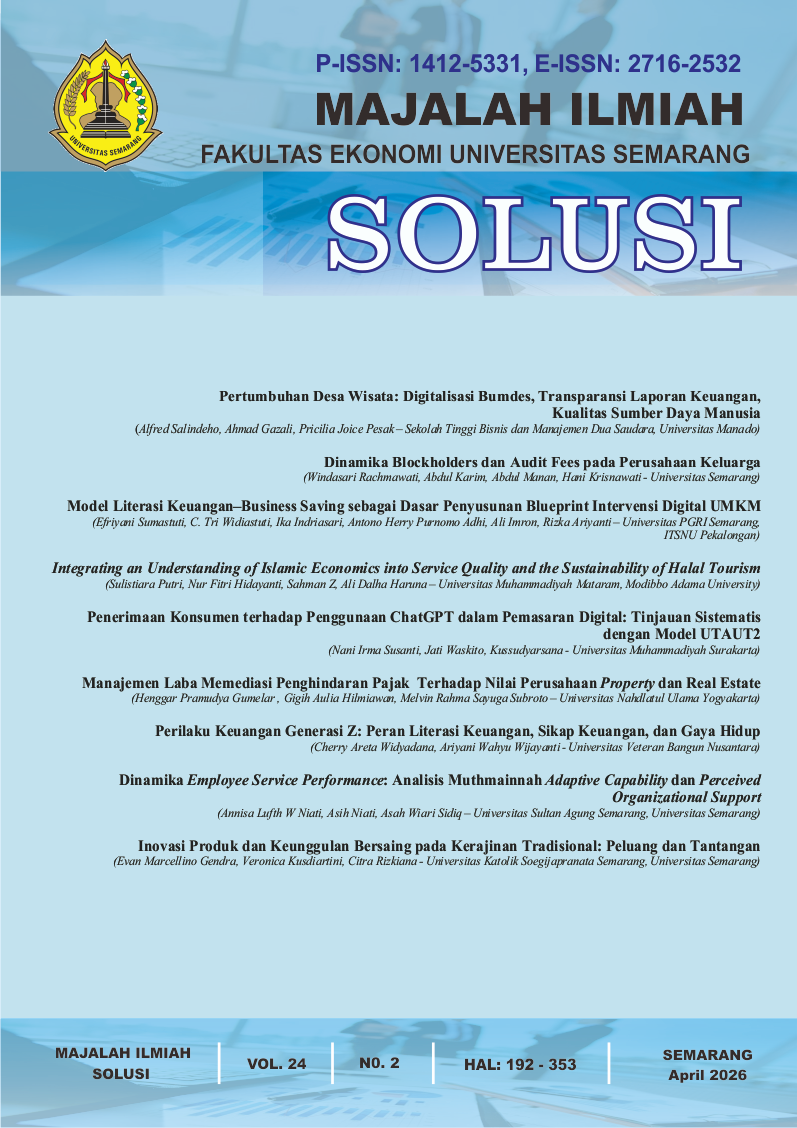
Dinamika Employee Service Performance: Analisis Muthmainnah Adaptive Capability dan Perceived Organizational Support 170 176
DOI:
https://doi.org/10.26623/slsi.v24i2.14364Abstract
Penelitian ini bertujuan untuk menganalisis pengaruh Muthmainnah Adaptive Capability (MAC) dan Perceived Organizational Support (POS) terhadap Employee Service Performance (ESP) baik secara langsung maupun melalui mediasi Job Satisfaction (JS) pada pegawai Pegadaian. Penelitian ini menggunakan pendekatan kuantitatif dengan metode survei. Teknik pengambilan sampel yang digunakan adalah purposive sampling, dengan jumlah responden sebanyak 124 pegawai Pegadaian yang memenuhi kriteria penelitian. Data dianalisis menggunakan metode Partial Least Squares–Structural Equation Modeling (PLS-SEM) melalui perangkat lunak SmartPLS. Hasil evaluasi model pengukuran menunjukkan bahwa seluruh konstruk memenuhi kriteria validitas konvergen, validitas diskriminan, serta reliabilitas yang sangat baik. Model struktural menunjukkan daya jelaskan yang kuat dengan nilai R² sebesar 0,820 untuk Job Satisfaction dan 0,780 untuk Employee Service Performance, serta nilai Q² yang mengindikasikan kemampuan prediktif model yang sangat baik. Hasil pengujian hipotesis menunjukkan bahwa MAC dan POS berpengaruh positif dan signifikan terhadap Job Satisfaction. Selain itu, MAC, POS, dan Job Satisfaction secara langsung berpengaruh positif dan signifikan terhadap Employee Service Performance. Job Satisfaction terbukti berperan sebagai mediator parsial dalam hubungan antara MAC dan ESP serta antara POS dan ESP. Temuan penelitian ini menegaskan bahwa kemampuan adaptif pegawai yang berbasis ketenangan batin, optimisme, amanah, dan kepatuhan nilai moral, serta dukungan organisasi yang dirasakan, mampu meningkatkan kepuasan kerja yang pada akhirnya memperkuat kualitas kinerja layanan pegawai. Penelitian ini memberikan kontribusi teoretis melalui pengembangan konsep adaptive capability berbasis nilai spiritual serta memberikan implikasi praktis bagi manajemen Pegadaian dalam penguatan strategi pengelolaan sumber daya manusia yang berorientasi pada kinerja layanan berkelanjutan.
References
Ajzen, I. (2012). The theory of planned behavior. Handbook of Theories of Social Psychology: Volume 1, 438–459. https://doi.org/10.4135/9781446249215.n22
Aldabbas, H., Pinnington, A., Lahrech, & Abdelmounaim. (2023). The influence of perceived organizational support on employee creativity: The mediating role of work engagement. Current Psychology, 42, 6501–6515. https://doi.org/10.1007/s12144-021-01992-1
Ashmos, D. P., & Duchon, D. (2000). Spirituality at Work A Conceptualization And Measure. Journal of Management Inquiry, 9(2), 134–145.
Audenaert, M., Vanderstraeten, A., & Buyens, D. (2017). When innovation requirements empower individual innovation: the role of job complexity. Personnel Review, 46(3), 608–623. https://doi.org/10.1108/PR-10-2014-0219
Bienstock, C. C., DeMoranville, C. W., & Smith, R. K. (2003). Organizational citizenship behavior and service quality. Journal of Services Marketing, 17(4), 357–378.
Blau, P. M. (1964). Justice in Social Exchange. Sociological Inquiry, 34(2), 193–206. https://doi.org/10.1111/j.1475-682X.1964.tb00583.x
Bormann, L. B. J. R. K. C. (2016). Integrating Leadership Research: A Meta-Analytical Test of Yukl’s Meta-Categories of Leadership. Personnel Review, 45(6), 1–52. https://doi.org/org/10.1108/PR-07-2014-0145
Bos, J. T., Donders, N. C. G. M., Bouwman-Brouwer, K. M., & Van der Gulden, J. W. J. (2009). Work characteristics and determinants of job satisfaction in four age groups: university employees’ point of view. International Archives of Occupational and Environmental Health, 82(10), 1249–1259.
Chaidir, J., Haerofiatna, H., Kania, D., & Wahyudi, W. (2023). Peran mediasi komitmen afektif pada persepsi dukungan organisasi terhadap kinerja karyawan. MBR (Management and Business Review), 7(1), 30–45. https://doi.org/10.21067/mbr.v7i1.8723
Chi, H., Vu, T., Nguyen, H. V., & Truong, T. H. (2023). How financial and non–financial rewards moderate the relationships between transformational leadership, job satisfaction, and job performance. Cogent Business and Management, 10(1). https://doi.org/10.1080/23311975.2023.2173850
Chiang, C.-F., & Hsieh, T.-S. (2012). The impacts of perceived organizational support and psychological empowerment on job performance: The mediating effects of organizational citizenship behavior. International Journal of Hospitality Management, 31(1), 180–190.
Chin, W. W. (1998). The partial least squares approach to structural equation modeling. In Modern methods for business research (pp. 295–336). Psychology Press.
Cicchetti, D. V. (1994). Guidelines, Criteria, and Rules of Thumb for Evaluating Normed and Standardized Assessment Instruments in Psychology. Psychological Assessment, 6(4), 284–290. https://doi.org/10.1037/1040-3590.6.4.284
Cohen, J. (2013). Statistical power analysis for the behavioral sciences. routledge.
Dubey, P., Pathak, A. K., & Sahu, K. K. (2023). Assessing the influence of effective leadership on job satisfaction and organisational citizenship behaviour. Rajagiri Management Journal, 17(3), 221–237. https://doi.org/10.1108/ramj-07-2022-0108
Eisenberger, R., Huntington, R., Hutchison, S., & Sowa, D. (1986a). Perceived organizational support. Journal of Applied Psychology, 71(3), 500.
Eisenberger, R., Huntington, R., Hutchison, S., & Sowa, D. (1986b). Percieve Organisational Support. Journal of Applied Psychology, 71(3), 500–507.
Eisenberger, R., Stinglhamber, F., Vandenberghe, C., Sucharski, I. L., & Rhoades, L. (2002). Perceived supervisor support: Contributions to perceived organizational support and employee retention. Journal of Applied Psychology, 87(3), 565–573. https://doi.org/10.1037/0021-9010.87.3.565
Eviana, N. (2024). The Role of Perceived Organizational Support (POS) and Employee Satisfaction to Enhance Employee Engagement: Does Gender and Tenure Matter? Jurnal Manajemen Bisnis, 15(1), 13–31. https://doi.org/10.18196/mb.v15i1.19529
Fang, Y., Chen, J., Wang, M., & Chen, C. (2019). The Impact of Inclusive Leadership on Employees ’ Innovative Behaviors : The Mediation of Psychological Capital. Frontiers in Physiology, 10(August), 1–11. https://doi.org/10.3389/fpsyg.2019.01803
Faradila, N., Heksarini, A., & Darma, D. C. (2020). Antecedents That Affect Job Satisfaction and Employee Performance. Saudi Journal of Business and Management Studies, 5(6), 293–302. https://doi.org/10.36348/sjbms.2020.v05i06.001
Fornell, C., & f. larcke, D. (1981). Fornell, C., & Larcker, D. F. (1981). Evaluating Structural Equation Models with Unobservable Variables and Measurement Error. Journal of Marketing Research, 18(1), 39–50.
Ghozali, I. (2011). Model Persamaan Struktural. Konsep dan Aplikasi Dengan Program Amos 19.0 (Cetakan 11). UNDIP Press.
Hair, J. F., Risher, J. J., Sarstedt, M., & Ringle, C. M. (2019). When to use and how to report the results of PLS-SEM. European Business Review, 31(1), 2–24.
Hair Jr, J. F., Hult, G. T. M., Ringle, C. M., Sarstedt, M., Danks, N. P., & Ray, S. (2021). Partial least squares structural equation modeling (PLS-SEM) using R: A workbook. Springer Nature.
Huntsman, D., Greer, A., Murphy, H., & Haynes, S. (2021). Enhancing adaptive performance in emergency response: Empowerment practices and the moderating role of tempo balance. Safety Science, 134(September 2020), 105060. https://doi.org/10.1016/j.ssci.2020.105060
Judge, T. A., Heller, D., & Mount, M. K. (2002). Five-factor model of personality and job satisfaction: a meta-analysis. Journal of Applied Psychology, 87(3), 530.
Judge, T. A., Thoresen, C. J., Bono, J. E., & Patton, G. K. (2001). The job satisfaction–job performance relationship: A qualitative and quantitative review. Psychological Bulletin, 127(3), 376.
Kaltiainen, J., & Hakanen, J. (2020). Fostering task and adaptive performance through employee well-being: The role of servant leadership. BRQ Business Research Quarterly. https://doi.org/10.1177/2340944420981599
Karatepe, O. M. (2015). Do personal resources mediate the effect of perceived organizational support on emotional exhaustion and job outcomes? International Journal of Contemporary Hospitality Management, 27(1), 4–26. https://doi.org/10.1108/IJCHM-09-2013-0417
Karatepe, O. M., & Uludag, O. (2007). Conflict, exhaustion, and motivation: A study of frontline employees in Northern Cyprus hotels. International Journal of Hospitality Management, 26(3), 645–665.
Kaur, P., Malhotra, K., & Sharma, S. K. (2020). Moderation-mediation framework connecting internal branding, affective commitment, employee engagement and job satisfaction: an empirical study of BPO employees in Indian context. Asia-Pacific Journal of Business Administration, 12(3–4), 327–348. https://doi.org/10.1108/APJBA-10-2019-0217
Lesmana, H., Indradewa, R., & Syah, T. Y. R. (2021). Organization Innovation Effect On Job Satisfaction And Employee Engagement Over Job Performance At PT. UTAC Manufacturing Services Indonesia. Journal of Multidisciplinary Academic, 5(3), 208–215. https://doi.org/10.51971/joma.v5n3.057602021
Liu, P., Yuan, Y., Yang, L., Liu, B., & Xu, S. (2023). Innovation comes with responsibility: a dual moderation model of taking charge and innovative job performance. European Journal of Innovation Management, 2020, 1460–1060. https://doi.org/10.1108/EJIM-08-2022-0420
Luthans, F. (2011a). Organizational Behavior An Evidence-Based Approach. McGraw-Hill/Irwin.
Luthans, F. (2011b). Organizational behavior an evidence-based approach twelfth edition. MC graw hill.
Luthans, F., Youssef, C. M., & Avolio, B. J. (2007). Psychological capital: Oxford University Press.
Mikkelsen, A., & Olsen, E. (2018). The influence of change-oriented leadership on work performance and job satisfaction in hospitals – the mediating roles of learning demands and job involvement. Leadership in Health Services, 1751–1879. https://doi.org/https://doi.org/10.1108/LHS-12-2016-0063 Downloaded
Muafi, Fachrunnisa, O., Siswanti, Y., El Qadri, Z. M., & Harjito, D. A. (2019). Empowering Leadership and Individual Readiness to Change: the Role of People Dimension and Work Method. Journal of the Knowledge Economy, 10(4), 1515–1535. https://doi.org/10.1007/s13132-019-00618-z
Mursidta, S. (2017). Pengaruh Perceived Organizational Support (Persepsi Dukungan Organisasi) Dan Kepuasan Kerja Terhadap Kinerja Karyawan Pada Pt. Varia Usaha Beton Gresik. Jurnal Ilmu Manajemen, 5(1), 1–12.
Negoro, M. C. W., & Wibowo, A. (2021). Empathetic Leadership, Job Satisfaction and Intention To Leave Among Millennials in a Start-Up Industry: Needs’ Satisfaction As a Mediating Variable. Journal of Indonesian Economy and Business, 36(2), 136–154. https://doi.org/10.22146/jieb.v36i2.1398
Niati, A., Fachrunnisa, O., & Sodikin, M. (2021). Muthmai’nnah Adaptive Capability: A Conceptual Reviewe. 324–331.
Niati, A., Fachrunnisa, O., Sodikin, M., Fakhruzein, Y., & Jaya, T. (2023). Muthmainnah Adaptive Capability : Conceptualization , Scale Development and Validation. 17(March), 331–344.
Pargament, K. I., Tarakeshwar, N., Ellison, C. G., & Wulff, K. M. (2001). Religious coping among the religious: The relationships between religious coping and well-being in a national sample of Presbyterian clergy, elders, and members. Journal for the Scientific Study of Religion, 40(3), 497–513. https://doi.org/10.1111/0021-8294.00073
Park, C. L. (2005). Religion as a meaning-making framework in coping with life stress. Journal of Social Issues, 61(4), 707–729. https://doi.org/10.1111/j.1540-4560.2005.00428.x
Perera, H. (2017). Profiles of career adaptivity and their relations with adaptability, adapting, and adaptation. Journal of Vocational Behavior, 98, 70–84. https://doi.org/10.1016/j.jvb.2016.10.001
Petchsawang, P., & Duchon, D. (2012). Journal of Management , Spirituality & Workplace spirituality , meditation , and work performance. Journal of Management , Spirituality & Religion, 9(2), 189–208. https://doi.org/org/10.1080/14766086.2012.688623
Pinnington, A. H., Aldabbas, H., Mirshahi, F., & Brown, M. L. (2024). Networks perceptions and job satisfaction: the mediating role of perceived organizational support for women’s work contribution. Baltic Journal of Management, 1746–5265. https://doi.org/10.1108/BJM-04-2023-0169
Popoola, S. O., & Fagbola, O. O. (2023). The Journal of Academic Librarianship Work motivation , job satisfaction , work-family balance , and job commitment of library personnel in Universities in North-Central Nigeria. The Journal of Academic Librarianship, 49(4), 102741. https://doi.org/10.1016/j.acalib.2023.102741
Rachman, T. A., Soetjipto, B. E., & Wardana, L. W. (2025). Literature Review Of Demographic Influences On Employee Performance In Manufacturing Companies In Developing Countries. International Journal of Humanity Advance, Business & Sciences (IJHABS), 2(4), 477–488.
Ryan, R. M., & Deci, E. L. (2024). Self-determination theory. In Encyclopedia of quality of life and well-being research (pp. 6229–6235). Springer.
Sarstedt, M., Hair Jr, J. F., Cheah, J.-H., Becker, J.-M., & Ringle, C. M. (2019). How to specify, estimate, and validate higher-order constructs in PLS-SEM. Australasian Marketing Journal, 27(3), 197–211.
Shaheen, A., Nawaz, M. K., Sattar, S., & Nawaz, S. (2024). Unveiling the Nexus : How High-Performance Work Practices Influence Employee Innovative Work Behavior through the Lens of Perceived Organizational Support. Journal of Excellence in Management Sciences (2024), 3(1), 85–100.
Silalahi, U. (2015). Metode Penelitian Sosial Kuantitatif (N. F. Atif (ed.); Edisi Revi). PT.Refika Aditama.
Sinisterra, L., Peñalver, J., & Salanova, M. (2024). Connecting the organizational incomes and outcomes: A systematic review of the relationship between talent management, employee engagement, and turnover intention. Frontiers in Psychology, 15, 1439127.
Slatten, T., Svensson, G., & Svaeri, S. (2011). Empowering leadership and the influence of a humorous work climate on service employees’ creativity and innovative behaviour in frontline service jobs. International Journal of Quality and Service Sciences, 3(3), 267–284. https://doi.org/10.1108/17566691111182834
Sudarti, K., Fachrunnisa, O., & Ratnawati, A. (2021). Can the sense of ta’awun behavior reduce voluntarily job turnover in Indonesia? Journal of Islamic Accounting and Business Research, 12(6), 831–848. https://doi.org/10.1108/JIABR-07-2019-0130
Sugiyono. (2017). Metode penelitian dan pengembangan : Research and development/R&D. ALFABETA.
Trabucchi, D., Bellis, P., Di Marco, D., Buganza, T., & Verganti, R. (2020). Attitude vs involvement: a systematic literature review at the intersection between engagement and innovation. European Journal of Innovation Management. https://doi.org/10.1108/EJIM-05-2020-0171
Vakola, M. (2014). What’s in there for me? Individual readiness to change and the perceived impact of organizational change. Leadership and Organization Development Journal, 35(3), 195–209. https://doi.org/10.1108/LODJ-05-2012-0064
Vidotto, J. D. F., Ferenhof, H. A., Selig, P. M., & Bastos, R. C. (2017). A human capital measurement scale. Journal of Intellectual Capital, 18(2), 316–329. https://doi.org/10.1108/JIC-08-2016-0085
Weiss, H. M., & Cropanzano, R. (1996). Affective events theory. Research in Organizational Behavior, 18(1), 1–74.
Widodo, A., & Rohman, F. (2019). Konsep Jiwa yang Tenang dalam Surat Al Fajr 27-30 (Perspektif Bimbingan Konseling Islam). AL-IRSYAD: Jurnal Bimbingan Konseling Islam, 1(2), 219–234.
Yoon, M. H., & Suh, J. (2003). Organizational citizenship behaviors and service quality as external effectiveness of contact employees. Journal of Business Research, 56(8), 597–611. https://doi.org/https://doi.org/10.1016/S0148-2963(01)00290-9
Yu, X., Li, D., Tsai, C. H., & Wang, C. (2019). The role of psychological capital in employee creativity. Career Development International, 24(5), 420–437. https://doi.org/10.1108/CDI-04-2018-0103
Zhao, Y. (2018). Managing Chinese millennial employees and their impact on human resource management transformation: an empirical study. Asia Pacific Business Review, 24(4), 472–489. https://doi.org/10.1080/13602381.2018.1451132
Downloads
Published
Issue
Section
License
Copyright (c) 2026 Annisa Lufth W Niati, Asih Niati, Asah Wiari Sidiq

This work is licensed under a Creative Commons Attribution 4.0 International License.
The author who will publish the manuscript at Solusi : Journal of Solusi, agree to the following terms:
|











 This work is licensed under a