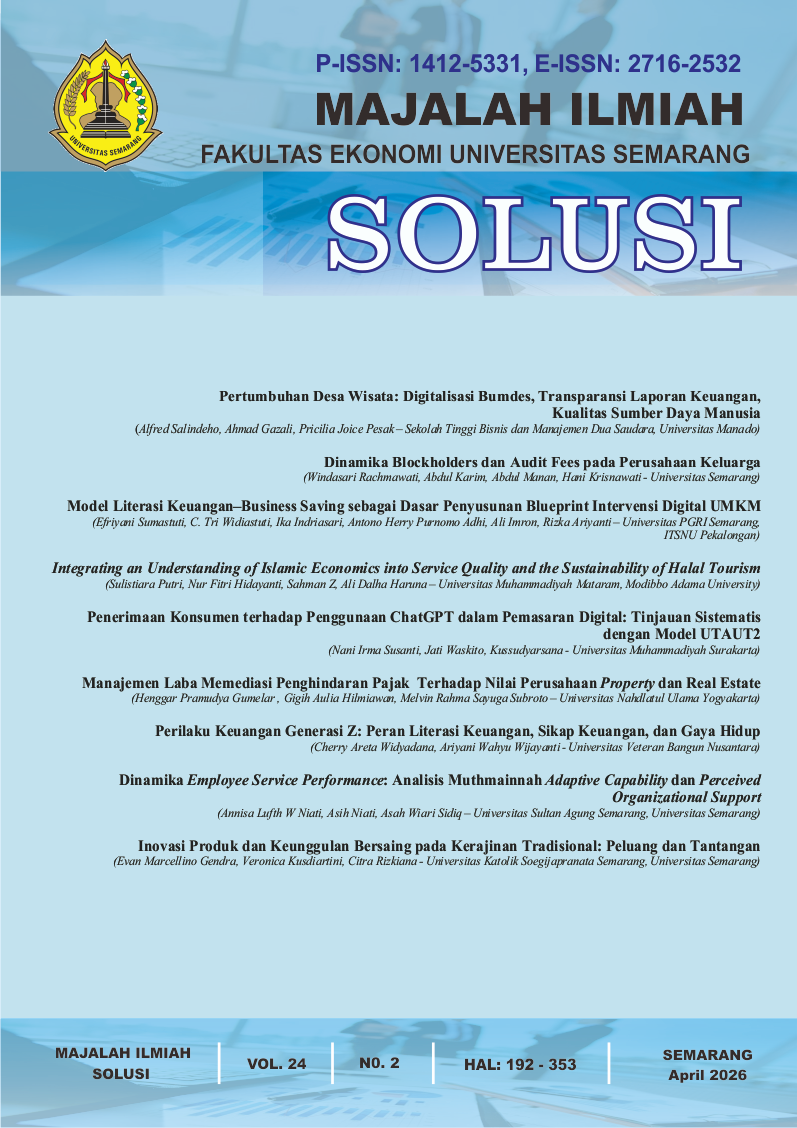
Penerimaan Konsumen terhadap Penggunaan ChatGPT dalam Pemasaran Digital: Tinjauan Sistematis dengan Model UTAUT2 304 279
DOI:
https://doi.org/10.26623/slsi.v24i2.14095Abstract
Penelitian ini bertujuan secara sistematis menggali faktor-faktor yang mempengaruhi penerimaan konsumen terhadap teknologi kecerdasan buatan (AI) generatif, khususnya ChatGPT, dalam kerangka pemasaran digital berbasis merek. Tinjauan Literatur Sistematis (SLR) dilakukan dengan menggunakan pendekatan PRISMA, mencakup 115 artikel peer-reviewed dari enam basis data akademik utama (Scopus, Web of Science, Springer, ScienceDirect, Emerald, dan EBSCO) yang mencakup periode 2021–2025. Temuan ini mengungkapkan bahwa model UTAUT2 adalah kerangka teoritis yang paling umum digunakan dalam 70,25% penelitian, menyoroti variabel inti seperti ekspektasi kinerja, motivasi hedonik, dan pengaruh sosial. Di samping itu, faktor-faktor yang muncul termasuk kecemasan AI, kepercayaan, dan nilai emosional semakin diintegrasikan untuk memperkaya daya penjelasan model. Hasil Penelitian mengidentifikasi tiga kategori pendekatan teoretis utama: kognitif-intentional (70,25%), teori berbasis norma (4,96%), dan pendekatan multidimensional yang mengintegrasikan aspek afektif dan identitas (38,84%). Selain itu, cara menilai suatu merek ternyata memiliki pengaruh penting terhadap apakah ada keinginan menggunakan suatu teknologi, tetapi hal ini masih jarang diteliti lebih dalam dalam model-model adopsi teknologi yang sudah ada. Analisis menunjukkan ada kesenjangan kritis antara niat perilaku (behavioral intention) dan perilaku penggunaan aktual, di mana hanya 16,47% penelitian yang melacak realisasi niat ke dalam tindakan dunia nyata. Studi ini memberikan kontribusi substansial dengan memetakan kesenjangan dan mengusulkan integrasi elemen branding ke dalam kerangka kerja UTAUT2, serta Integrasi yang dimaksudkan adalah untuk mendukung strategi pemasaran lebih beresonansi secara emosional, etis, dan inklusif di era transformasi digital.
References
Acquah, B. Y. S., Arthur, F., Salifu, I., Quayson, E., & Nortey, S. A. (2024). Preservice teachers’ behavioural intention to use artificial intelligence in lesson planning: A dual-staged PLS-SEM-ANN approach. Computers and Education: Artificial Intelligence, 7, 100307. https://doi.org/10.1016/J.CAEAI.2024.100307
Al-Abdullatif, A. M., & Alsubaie, M. A. (2024). ChatGPT in Learning: Assessing Students’ Use Intentions through the Lens of Perceived Value and the Influence of AI Literacy. Behavioral Sciences, 14(9). https://doi.org/10.3390/bs14090845
Ali, M. S. M., Wasel, K. Z. A., & Abdelhamid, A. M. M. (2024). Generative AI and Media Content Creation: Investigating the Factors Shaping User Acceptance in the Arab Gulf States. Journalism and Media, 5(4), 1624–1645. https://doi.org/10.3390/journalmedia5040101
Amer jid Almahri, F. A., Bell, D., & Gulzar, Z. (2024). Chatbot Technology Use and Acceptance Using Educational Personas. Informatics, 11(2). https://doi.org/10.3390/informatics11020038
Arviani, H., Tutiasri, R. P., Fauzan, L. A., & Kusuma, A. (2023). ChatGPT For Marketing Communications: Friend or Foe? Kanal: Jurnal Ilmu Komunikasi, 12(1), 1–7. https://doi.org/10.21070/kanal.v12i1.1729
Baabdullah, A. M. (2024). The precursors of AI adoption in business: Towards an efficient decision-making and functional performance. International Journal of Information Management, 75(September 2023), 102745. https://doi.org/10.1016/j.ijinfomgt.2023.102745
Benchaita, S., & Relations, I. M. (n.d.). Data Suggests Growth in Enterprise Adoption of AI is Due to Widespread Deployment by Early Adopters, But Barriers Keep 40% in the Exploration and Experimentation Phases. IBM. https://newsroom.ibm.com/2024-01-10-Data-Suggests-Growth-in-Enterprise-Adoption-of-AI-is-Due-to-Widespread-Deployment-by-Early-Adopters?cm_cat=google&cm_ite=Cisco+Collaboration+B&cm_mmc=Vanity-_-digital-experience--_-092123&cm_pla=S3+Cisco+Systems&cm_ven=acquirgy&ef_id=Cj0KCQjwn7mwBhCiARIsAGoxjaKnoBlUCHNfgwPmi9uOVzGAYDL2NqHHZME_StL5uJlzinTL75Ty-zIaAksWEALw_wcB%3AG%3As&gad_source=1&newstype=Press+Release&page=1&s_kwcid=AL%214223%213%21691480575277%21b%21%21g%21%21cisco+collaboration+services%21889059576%2144248994333&zContent=Control-Manager-65804521&zPage=Overview-f032329d&utm_source=chatgpt.com
Brooks, D., & McNeely, M. (2013). L’importance de rapports transparents des revues systématiques. Physiotherapy Canada, 65(1), 1–2. https://doi.org/10.3138/ptc.65.1.GEE
Cobelli, N., & Blasi, S. (2024). Combining topic modeling and bibliometric analysis to understand the evolution of technological innovation adoption in the healthcare industry. European Journal of Innovation Management, 27(9), 127–149. https://doi.org/10.1108/EJIM-06-2023-0497
Cugler, E., Silva, M., & Carlos Vaz, J. (2024). How disinformation and fake news impact public policies A review of international literature. 1–48. https://arxiv.org/abs/2406.00951
Elinzano, G. B. O., & Ching, M. R. (2024). Determinants of ChatGPT Adoption in Academe & Other Fields – A Review on Theoretical Perspective. International Conference on Computers in Education. https://doi.org/10.58459/icce.2024.4969
Ermakova, T. (2015). U Nderstanding P Hysicians ’ a Doption of H Ealth C Louds. Computer Science & Information Technology (CS & IT), 23, 17–24.
Giamouzi, M. (2017). City , University of London Institutional Repository. City Research Online, 34(3), 51–79. https://doi.org/10.1177/02734753241302459/This
Gough, D., Thomas, J., & Oliver, S. (2019). Clarifying differences between reviews within evidence ecosystems. Systematic Reviews, 8(1), 1–15. https://doi.org/10.1186/s13643-019-1089-2
Graham, C., & Stough, R. (2025). Consumer perceptions of AI chatbots on Twitter (X) and Reddit: an analysis of social media sentiment and interactive marketing strategies. Journal of Research in Interactive Marketing, X. https://doi.org/10.1108/JRIM-05-2024-0237
Gruber, M. (2020). An evolutionary perspective on adoption-di ff usion theory. 116(March), 2963.
Hu, X. (2024). Generative AI Impact on Marketing Agency. Advances in Economics, Management and Political Sciences, 92(1), 240–248. https://doi.org/10.54254/2754-1169/92/20231109
Jo, H. (2024). Subscription intentions for ChatGPT plus: a look at user satisfaction and self-efficacy. Marketing Intelligence and Planning, 42(6), 1052–1073. https://doi.org/10.1108/MIP-08-2023-0411
Jowarder, M. I. (2023). The Influence of ChatGPT on Social Science Students: Insights Drawn from Undergraduate Students in the United States. Indonesian Journal of Innovation and Applied Sciences (IJIAS), 3(2), 194–200. https://doi.org/10.47540/ijias.v3i2.878
Kang, S., Choi, Y., & Kim, B. (2025). Impact of generative AI service adoption intent on user attitudes: Focusing on the Unified Theory of Acceptance and Use of Technology. International Journal of Innovative Research and Scientific Studies, 8(1), 2021–2033. https://doi.org/10.53894/ijirss.v8i1.4874
Kumawat, E., Datta, A., Prentice, C., & Leung, R. (2025). Artificial intelligence through the lens of hospitality employees: A systematic review. International Journal of Hospitality Management, 124, 103986. https://doi.org/10.1016/J.IJHM.2024.103986
Lai, C. Y., Cheung, K. Y., & Chan, C. S. (2023). Exploring the role of intrinsic motivation in ChatGPT adoption to support active learning: An extension of the technology acceptance model. Computers and Education: Artificial Intelligence, 5, 100178. https://doi.org/10.1016/J.CAEAI.2023.100178
Ledoh, C. C., Judijanto, L., Jumiono, A., Apriyanto, A., & Hakpantria, H. (2024). Revolusi Industri 5.0: Kesiapan Generasi-Z dalam Menghadapi Persaingan Global. PT. Sonpedia Publishing Indonesia.
Lee, K., Yan, A., & Joshi, K. (2011). Understanding the dynamics of users’ belief in software application adoption. International Journal of Information Management, 31(2), 160–170. https://doi.org/10.1016/j.ijinfomgt.2010.07.009
Leppin, A. L., Bora, P. R., Tilburt, J. C., Gionfriddo, M. R., Zeballos-Palacios, C., Dulohery, M. M., Sood, A., Erwin, P. J., Brito, J. P., Boehmer, K. R., & Montori, V. M. (2014). The efficacy of resiliency training programs: A systematic review and meta-analysis of randomized trials. PLoS ONE, 9(10). https://doi.org/10.1371/JOURNAL.PONE.0111420
Liberati, A., Altman, D. G., Tetzlaff, J., Mulrow, C., Gøtzsche, P. C., Ioannidis, J. P. A., Clarke, M., Devereaux, P. J., Kleijnen, J., & Moher, D. (2009). The PRISMA statement for reporting systematic reviews and meta-analyses of studies that evaluate health care interventions: explanation and elaboration. Journal of Clinical Epidemiology, 62(10), e1–e34. https://doi.org/10.1016/j.jclinepi.2009.06.006
Mahmud, A., Sarower, A. H., Sohel, A., Assaduzzaman, M., & Bhuiyan, T. (2024). Adoption of ChatGPT by university students for academic purposes: Partial least square, artificial neural network, deep neural network and classification algorithms approach. Array, 21, 100339. https://doi.org/10.1016/J.ARRAY.2024.100339
Maican, C. I., Sumedrea, S., Tecau, A., Nichifor, E., Chitu, I. B., Lixandroiu, R., & Bratucu, G. (2023). Factors Influencing the Behavioural Intention to Use AI-Generated Images in Business: A UTAUT2 Perspective With Moderators. Journal of Organizational and End User Computing, 35(1), 1–32. https://doi.org/10.4018/JOEUC.330019
Mari, A., Mandelli, A., & Algesheimer, R. (2024). Empathic voice assistants: Enhancing consumer responses in voice commerce. Journal of Business Research, 175, 114566. https://doi.org/10.1016/J.JBUSRES.2024.114566
Mariñas, K. A., Saflor, C. S., Alvarado, P., Uminga, J. M., & Verde, N. A. (2025). Assessing the importance of variables from a revised technology acceptance model for the use of ChatGPT by university students. Computers and Education: Artificial Intelligence, 9(May). https://doi.org/10.1016/j.caeai.2025.100435
Mohamed Eldakar, Metwaly Ali, Khafaga Shehata, Ahmed Maher, & Abdelrahman Ammar, Abdelrahman Saber. (2025). What motivates academics in Egypt toward generative AI tools? An integrated model of TAM, SCT, UTAUT2, perceived ethics, and academic integrity. Information Development, 02666669251314859. https://doi.org/10.1177/02666669251314859
Nasr, R. S., & El‐Deeb, S. (2025). Generative AI and Its Potential Impact on Humanity. International Journal of Consumer Studies, 49(1), e70024.
Nguyet, D. T. C. (2024). Adoption of Generative AI in content creation: A case study from the advertising industry. 2024 IEEE Conference on Artificial Intelligence (CAI), 111–112. https://doi.org/10.1109/CAI59869.2024.00029
Page, M. J., McKenzie, J. E., Bossuyt, P., Boutron, I., Hoffmann, T. C., Mulrow, C. D., Shamseer, L., Tetzlaff, J. M., Akl, E., Brennan, S. E., Chou, R., Glanville, J., Grimshaw, J. M., Hróbjartsson, A., Lalu, M. M., Li, T., Loder, E. W., Mayo-Wilson, E., McDonald, S., … Moher, D. (2021). The prisma 2020 statement: An updated guideline for reporting systematic reviews. In Medicina Fluminensis (Vol. 57, Issue 4, pp. 444–465). https://doi.org/10.21860/medflum2021_264903
Page, M. J., Moher, D., Bossuyt, P. M., Boutron, I., Hoffmann, T. C., Mulrow, C. D., Shamseer, L., Tetzlaff, J. M., Akl, E. A., Brennan, S. E., Chou, R., Glanville, J., Grimshaw, J. M., Hróbjartsson, A., Lalu, M. M., Li, T., Loder, E. W., Mayo-Wilson, E., Mcdonald, S., … Mckenzie, J. E. (2021). PRISMA 2020 explanation and elaboration: Updated guidance and exemplars for reporting systematic reviews. The BMJ, 372. https://doi.org/10.1136/bmj.n160
Pielken, H. J., Urbanitz, D., Koch, P., & van de Loo, J. (1987). Immunological monitoring in remission acute myeloid leukemia during maintenance therapy. Haematology and Blood Transfusion, 30, 385–386. https://doi.org/10.1007/978-3-642-71213-5_65
Reuters. (n.d.). Adobe raises annual forecasts on steady adoption of AI-powered tools. https://www.reuters.com/business/adobe-raises-annual-forecasts-steady-adoption-ai-powered-tools-2025-06-12/?utm_source=chatgpt.com
Robertson, J., Botha, E., Oosthuizen, K., & Montecchi, M. (2025). Managing change when integrating artificial intelligence (AI) into the retail value chain: The AI implementation compass. Journal of Business Research, 189, 115198. https://doi.org/10.1016/J.JBUSRES.2025.115198
Salifu, I., Arthur, F., Arkorful, V., Abam Nortey, S., & Solomon Osei-Yaw, R. (2024). Economics students’ behavioural intention and usage of ChatGPT in higher education: a hybrid structural equation modelling-artificial neural network approach. Cogent Social Sciences, 10(1). https://doi.org/10.1080/23311886.2023.2300177
Samuel Inbaraj, L. M., Hamzah, M., & Apatura, N. (2024). Perception and Attitudes towards AI (ChatGPT) in Education: A Focus on TESL Students in Perak. Progress in Computers and Learning, 1(1), 1–10. https://doi.org/10.37934/picl.1.1.110
Schiaroli, V., Alvino, L., Verdonk, E., Dangelico, R. M., & Fraccascia, L. (2025). Sustainability across Borders: which factors influence sustainable footwear Choices? An empirical study on Italian and Dutch consumers. Journal of Cleaner Production, 521(October 2024), 146133. https://doi.org/10.1016/j.jclepro.2025.146133
Singh, J. J., Iglesias, O., & Batista-Foguet, J. M. (2012). Does Having an Ethical Brand Matter? The Influence of Consumer Perceived Ethicality on Trust, Affect and Loyalty. Journal of Business Ethics, 111(4), 541–549. https://doi.org/10.1007/s10551-012-1216-7
Snyder, H. (2019). Literature review as a research methodology: An overview and guidelines. Journal of Business Research, 104(March), 333–339. https://doi.org/10.1016/j.jbusres.2019.07.039
Solórzano Solórzano, S. S., Pizarro Romero, J. M., Díaz Cueva, J. G., Arias Montero, J. E., Zamora Campoverde, M. A., Lozzelli Valarezo, M. M., Montes Ninaquispe, J. C., Acosta Enriquez, B. G., & Arbulú Ballesteros, M. A. (2024). Acceptance of artificial intelligence and its effect on entrepreneurial intention in foreign trade students: a mirror analysis. Journal of Innovation and Entrepreneurship, 13(1). https://doi.org/10.1186/s13731-024-00412-5
Ullah, S. (2025). Intention to Use Cryptocurrencies for Business Transactions: The Case of North Carolina. Journal of Risk and Financial Management, 18(2). https://doi.org/10.3390/jrfm18020058
Urbani, R., Ferreira, C., & Lam, J. (2024). Managerial framework for evaluating AI chatbot integration: Bridging organizational readiness and technological challenges. Business Horizons, 67(5), 595–606. https://doi.org/10.1016/J.BUSHOR.2024.05.004
Venkatesh, V., Thong, J. Y. L., & Xu, X. (2016). Unified theory of acceptance and use of technology: A synthesis and the road ahead. Journal of the Association for Information Systems, 17(5), 328–376. https://doi.org/10.17705/1jais.00428
Wang, L., Xu, S., & Liu, K. (2024). Understanding students’ acceptance of ChatGPT as a translation tool: A UTAUT model analysis. Understanding Students’ Acceptance of ChatGPT as a Translation Tool: A UTAUT Model Analysis.
Wang, R., Duan, Y., & Fu, Z. (2011). Understanding ICTs adoption from an evolutionary process perspective. International Conference on Management and Service Science, MASS 2011. https://doi.org/10.1109/ICMSS.2011.5998984
Yeoh, R. Q., Perumal, S., & Jaganathan, M. (2025). A bibliometric analysis: The R-tool for analysing the technology acceptance model (TAM) in scopus. Multidisciplinary Reviews, 8(5). https://doi.org/10.31893/multirev.2025149
Yin, M., Han, B., Ryu, S., & Hua, M. (2023). Acceptance of generative AI in the creative industry: Examining the role of AI anxiety in the UTAUT2 model. International Conference on Human-Computer Interaction, 288–310.
Zhou, C., Li, H., & Bian, Y. (2020). Identifying the Optimal 3D Display Technology for Hands-On Virtual Experiential Learning: A Comparison Study. IEEE Access, 8, 73791–73803. https://doi.org/10.1109/ACCESS.2020.2988678
Downloads
Published
Issue
Section
License
Copyright (c) 2026 Nani Irma Susanti, Jati Waskito, Kussudyarsana

This work is licensed under a Creative Commons Attribution 4.0 International License.
The author who will publish the manuscript at Solusi : Journal of Solusi, agree to the following terms:
|













 This work is licensed under a