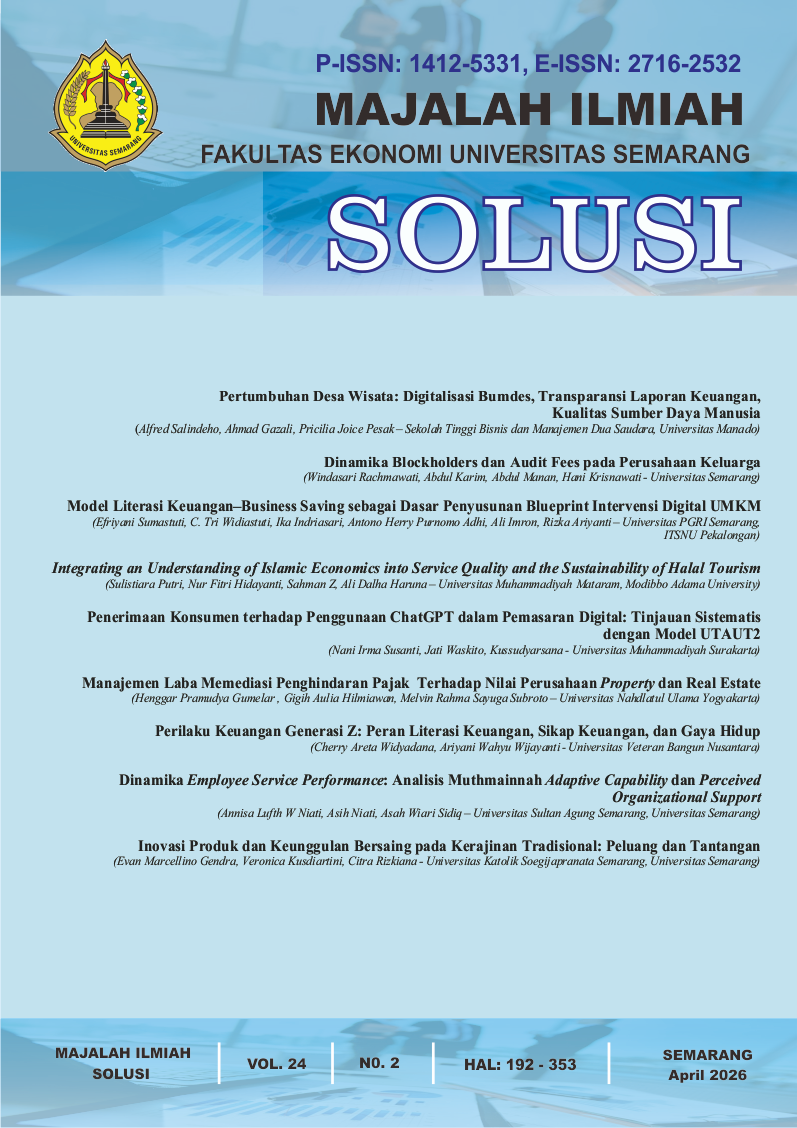
Integrating an Understanding of Islamic Economics into Service Quality and the Sustainability of Halal Tourism 144 158
DOI:
https://doi.org/10.26623/slsi.v24i2.14068Abstract
This study aims to examine the effect of Islamic economic understanding on service quality and the sustainability of halal tourism in West Nusa Tenggara Province. This research employs a quantitative approach using linear regression analysis with a sample of 108 respondents consisting of halal tourism service providers and users. The study proposes three hypotheses: (H1) An understanding of Islamic economics is predicted to have a positive and significant impact on the quality of halal tourism services; (H2) Service quality is assumed to have a positive and significant impact on the sustainability of halal tourism; and (H3) This study examines whether an understanding of Islamic economics directly contributes positively and significantly to the long-term sustainability of halal tourism. The results indicate that Islamic economic understanding has a positive and significant effect on both service quality and halal tourism sustainability. The regression analysis shows that the independent variable significantly contributes to the model, with a coefficient of 0.488 (t = 5.813, p < 0.001) for service quality and 0.427 (t = 6.132, p < 0.001) for sustainability. The model explains 24.2% of the variance in service quality and 26.2% in halal tourism sustainability, indicating moderate explanatory power. These findings suggest that a higher level of Islamic economic understanding among tourism stakeholders leads to improved service quality and strengthens the sustainability of halal tourism destinations. Therefore, this study recommends enhancing Islamic economic literacy and implementing structured training programs for industry players to ensure the consistent application of Sharia principles in service practices and destination management.
References
Anggela, C., Wahidah, F., & Putri, N. A. (2024). Kontribusi ekonomi syariah terhadap pembangunan berkelanjutan di Indonesia: Perspektif 2023-2024. Journal of Sharia Economics, 6(2), 168–177. https://doi.org/10.35896/jse.v6i2.945
Awara, G. P., Ali, K. S., Pradana, M. F. N., & Nurhasanah, Y. I. (2025). Filsafat ilmu Islam: implementasi nilai tauhid dalam aktivitas ekonomi Islam. Media Riset Bisnis Ekonomi Sains dan Terapan, 4(2), 91–100. https://doi.org/10.71312/mrbest.v4i2.754
Azwar, A., Wawan, M. A., & Siradjuddin, S. (2025). Al-Qiblah: Jurnal Studi Islam dan Bahasa Arab, 4(6), 782–811. https://doi.org/10.36701/qiblah.v4i6.2668
Fadhil, A. S., & Gani, I. (2026). Analisis pengaruh manajemen syariah terhadap kinerja organisasi . Ekonomipedia Jurnal Ekonomi Manajemen dan Bisnis, 4(1), 24–35. https://doi.org/10.55043/ekonomipedia
Fajriyati, D. N., Rahmatika, A. N., & Widyaningsih, B. (2025). Integrasi nilai-nilai syariah dalam manajemen sumber daya manusia konteks ekonomi Islam. QOSIM : Jurnal Pendidikan, Sosial & Humaniora, 3(3), 1261–1273. https://doi.org/10.61104/jq.v3i3.1973
Fatimah, S., & Sugianto, S. (2024). Pengaruh religius, kualitas layanan, citra destinasi, dan wisata halal terhadap minat wisatawan Muslim. Abdurrauf Social Science, 1(2), 182–200. https://doi.org/10.70742/arsos.v1i2.52
Hidayati, D., Fasa, M. I., & Susanto, I. (2024). Pengaruh pemasaran syariah terhadap kepercayaan konsumen di bank syariah. JICN: Jurnal Intelek dan Cendikiawan Nusantara, 1(5), 7545–7558. https://ciptakind-publisher.com/jumati/index.php/ojs/article/view/198
Khaerul, K. (2025). Etika bisnis dalam Islam: analisis perbandingan antara prinsip etika bisnis Islam dan konsep corporate social responsibility. Jurnal Kewirausahaan, 11(2), 102–107. https://journal.stieamsir.ac.id/index.php/man/article/view/596
Lahuri, S. Bin, & Purnamasari, F. W. (2024). Kajian kritis literasi halal dalam pariwisata : penyelenggaraan biro perjalanan berdasarkan Fatwa DSN-MUI No . 108/2016. INNOVATIVE ; Journal of Social Science Research, 4(5), 2380–2394. https://doi.org/10.31004/innovative.v4i5.15109
Mustaqim, D. Al. (2023). Strategi pengembangan pariwisata halal sebagai pendorong ekonomi berkelanjutan berbasis maqashid syariah. AB-JOIEC: Al-Bahjah Journal of Islamic Economics, 1(1), 44–55. https://doi.org/10.61553/abjoiec.v1i1.22
Pandiangan, D. F., & Meyniar, A. (2025). Model dan tahapan penelitian kuantitatif : pendekatan teoretis dan praktis dalam kajian pendidikan. IHSAN : Jurnal Pendidikan Islam, 3(3), 724–730. https://doi.org/10.61104/ihsan.v3i3.1494
Rahmawati, F., Othman, N., & Sunanti, M. A. (2018). Kepuasan wisatawan muslim pada pariwisata halal di Lombok. Muslim Tourist Satisfaction of Halal Tourism, 4(2), 122–129. https://doi.org/10.30997/jsei.v4i2.1501
Ruwaidah, S. H. (2020). Pengaruh literasi keuangan syariah dan shariah governance terhadap keputusan mahasiswa dalam menggunakan jasa perbankan syariah. Mahasabatuna; Jurnal Akuntansi dan Keuangan Islam, 1(1), 79–106. https://pdfs.semanticscholar.org/75b0/dce588ebe4cdca3e83a14fcd0829d4bf604e.pdf
Safitri, D., Hasany, T. D., Cahyaningrum, D., Asri, N. W. A. M., & Ibrahim, I. D. K. I. (2025). Analisis revisit intention wisatawan ke Lombok: pemahaman strategis untuk manajemen pemasaran pariwisata halal yang efektif. Jurnal Ekonomia, 15(2), 58–74. https://ejournal.uniled.ac.id/index.php/Uniled-Ekonomia/article/view/402
Sartika, D. (2020). Melihat attitude and behavior manusia lewat analisis teori planned behavioral. Journal of Islamic Guidance and Counseling, 4(1), 51–70. https://doi.org/10.30631/jigc.v4i1.40
Sugito, S. (2025). Internalisasi nilai-nilai komunikasi islami dalam praktik bisnis syariah di rokah hilir: pendekatan fenomenologis. JQIM, 5(1), 19–36. https://doi.org/10.55438/jqim.v5i1.210
Sutrisno, A., & Kadri, M. (2026). Internalisasi nilai PAI dalam praktik pelayanan pariwisata : Studi lapangan pada hotel dan usaha wisata di Kota Ende. Bayt al-Hikmah, 2(1), 93–107. https://doi.org/10.54065/baytal-hikmah.617
Wahidillah, N., Apriyani, S. R., Meilani, V. R., & Ashari, Z. M. (2025). Pelayanan publik dalam perspektif Islam : Landasan, prinsip, dan implementasi di era kontemporer. Kajian Administrasi Publik dan Ilmu Komunikasi, 2(3). https://doi.org/10.62383/kajian.v2i3.488
Wibowo, I. A., & Fatwa, N. (2024). Peluang pengembangan pariwisata halal melalui optimalisasi wakaf di Daerah Istimewa Yogyakarta. El-Mal: Jurnal Kajian Ekonomi & Bisnis Islam, 5(12), 5363–5380. https://doi.org/10.47467/elmal.v5i12.5330
Wicaksono, R. G. (2024). Upaya membangun ekosistem pariwisata halal melalui inovasi fasilitas, kolaborasi, dan pengalaman wisatawan Muslim. Creative Economics, Trading and Halal Ecosystem (CETHE), 2(1), 28–45. https://jurnal.gerakanedukasi.com/index.php/CETHE/article/view/198
Downloads
Published
Issue
Section
License
Copyright (c) 2026 Sulistiara Putri, Nur Fitri Hidayanti, Sahman Z, Ali Dalha Haruna

This work is licensed under a Creative Commons Attribution 4.0 International License.
The author who will publish the manuscript at Solusi : Journal of Solusi, agree to the following terms:
|










 This work is licensed under a