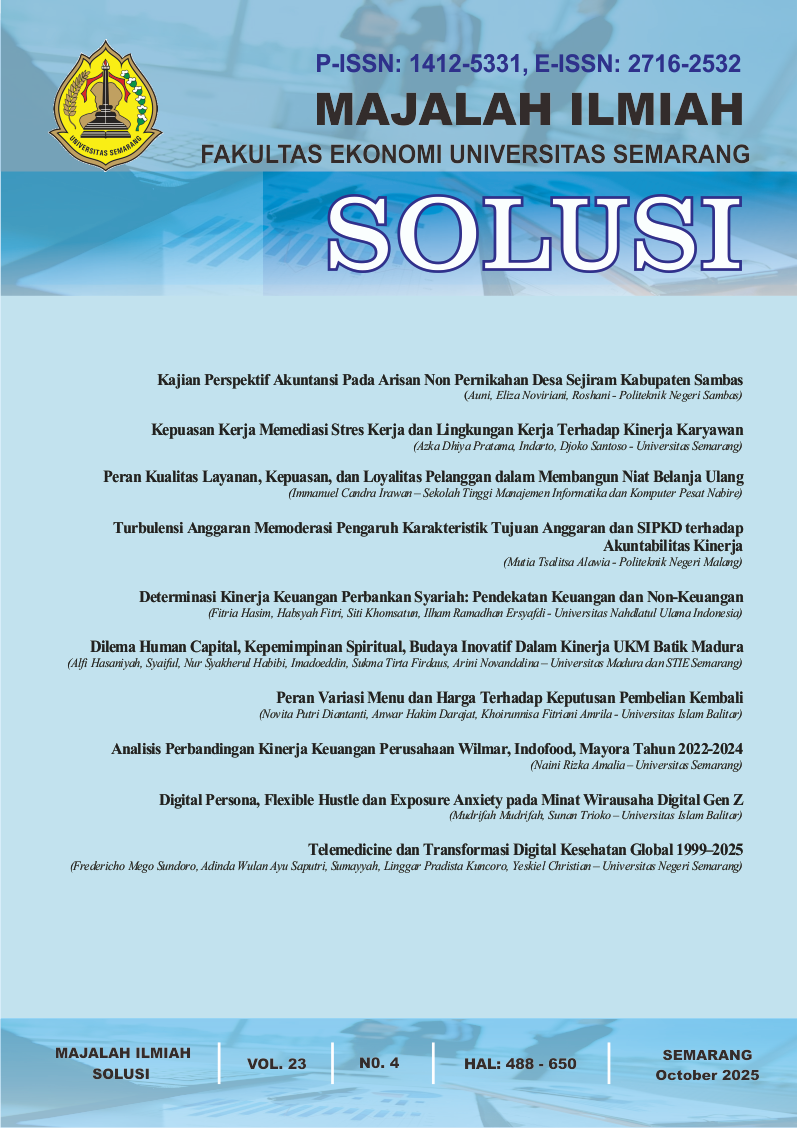
Digital Persona, Flexible Hustle dan Exposure Anxiety pada Minat Wirausaha Digital Gen Z 493 449
DOI:
https://doi.org/10.26623/slsi.v23i4.13048Abstract
Fenomena meningkatnya ketertarikan Generasi Z terhadap kewirausahaan digital di tengah tekanan ekonomi kreatif, persaingan platform daring, dan tuntutan pencitraan diri di media sosial menunjukkan munculnya tantangan baru dalam membangun identitas dan motivasi berwirausaha digital. Penelitian ini bertujuan untuk memahami secara mendalam bagaimana digital persona, flexible hustle, dan exposure anxiety membentuk minat berwirausaha digital pada Generasi Z di Kota Blitar. Pendekatan yang digunakan adalah kualitatif interpretatif dengan desain fenomenologi, yang memungkinkan peneliti menggali makna subjektif pengalaman individu dalam konteks digital entrepreneurship. Data dikumpulkan melalui wawancara mendalam terhadap sepuluh informan yang terdiri atas pelaku dan calon wirausaha digital, kemudian dianalisis menggunakan analisis tematik berdasarkan tahapan Braun dan Clarke. Hasil penelitian mengungkapkan tiga tema utama. Pertama, digital persona yang autentik berperan sebagai modal sosial digital, membangun kepercayaan publik dan memperkuat reputasi daring yang menjadi fondasi bagi aktivitas kewirausahaan. Kedua, flexible hustle muncul sebagai strategi adaptif yang membantu Gen Z menavigasi keterbatasan pasar kerja formal melalui kreativitas, fleksibilitas waktu, dan kemampuan lintas platform digital. Ketiga, exposure anxiety menciptakan ambivalensi emosional yang, meskipun semula menekan, dapat bertransformasi menjadi motivasi reflektif untuk belajar, beradaptasi, dan meningkatkan kapasitas diri. Ketiga tema tersebut saling berinteraksi secara dinamis, membentuk pola reflektif yang memperkuat minat berwirausaha digital. Secara teoretis, penelitian ini memperluas Theory of Planned Behavior dengan menambahkan dimensi digitalitas dan dinamika psikososial khas Generasi Z. Secara praktis, hasil penelitian menegaskan pentingnya identitas digital yang autentik, fleksibilitas kerja kreatif, dan literasi emosional digital sebagai prasyarat tumbuhnya kewirausahaan muda di era ekonomi digital.
References
Abd Hafidz, N. H., & Aziz, F. M. M. (2025). The Development of ASEAN Digital Economy: A Case Study on Economic Growth and Challenges from 2019 to 2023. Paper presented at the Proceedings of the 2nd International Conference on Administrative Science (ICAS 2024). doi: http://10.2991/978-94-6463-791-5_11
Ajzen, I. (1991). The theory of planned behavior. Organizational behavior and human decision processes, 50(2), 179-211. doi: https://doi.org/10.1016/0749-5978(91)90020-T
Alhaimer, R. S. (2023). Unveiling the digital persona image: the influence of social media on political candidates’ brand personality and voter behaviour in Kuwait. Humanities and Social Sciences Communications, 10(1), 1-12. doi: http//10.1057/s41599-023-02420-4
Azeem, M. M., & Kotey, B. (2023). Innovation in SMEs: The role of flexible work arrangements and market competition. The International Journal of Human Resource Management, 34(1), 92-127. doi: http//10.1080/09585192.2021.1961162
Braun, V. a. C., V. . (2006). Using Thematic Analysis in Psychology. Qualitative Research in Psychology(3), 77-100. doi:https://dx.doi.org/10.1191/1478088706qp063oa
Chen, Y., Li, S., Tian, Y., Li, D., & Yin, H. (2024). Problematic social media use may be ruining our sleep: A meta-analysis on the relationship between problematic social media use and sleep quality. International Journal of Mental Health and Addiction, 1-36. doi: https://doi.org/10.1007/s11469-024-01407-9
Creswell, J. W., & Poth, C. N. (2016). Qualitative inquiry and research design: Choosing among five approaches: Sage publications.
Delavani, E. (2025). Freelancer di Industri Kreatif: Analisis Mendalam Tentang Fleksibilitas dan Ketidakpastian. Universitas Islam Indonesia. dspace.uii.ac.id/123456789/56052
Festinger, L. (1954). A theory of social comparison processes. Human relations, 7(2), 117-140. doi: https://doi.org/10.1177/001872675400700202
Firk, S., Gehrke, Y., & Wolff, M. (2024). Digital anxiety in the finance function: Consequences and mitigating factors. Journal of Management Accounting Research, 36(1), 95-118. Firk, Sebastian and Gehrke, Yannik and Wolff, Michael, Digital Anxiety in the Finance Function: Consequences and Mitigating Factors (April 4, 2023). Journal of Management Accounting Research, Forthcoming, Available at SSRN: https://ssrn.com/abstract=4446237
Giles-Mathis, I. (2023). The Experience of Resilience and Striving for Self-Improvement Among Adults. Capella University. doi: https://doi.org/10.53797/icccmjssh.v4i1.2.2025%20
Goffman, E. (1959). The moral career of the mental patient. Psychiatry, 22(2), 123-142. doi:https://doi.org/10.1080/00332747.1959.11023166
Guba, E. G., & Lincoln, Y. S. (1989). Fourth generation evaluation. Sage. cirp.org/reference/referencespapers?referenceid=494371
Hotijah, S., & Novita, Y. (2025). Pengaruh Pendidikan Kewirausahaan, Efikasi Diri, dan Lingkungan Terhadap Minat Berwirausaha. Jurnal Pendidikan Sosial dan Humaniora, 4(2), 4021-4025. https://publisherqu.com/index.php/pediaqu/article/view/2140
Irena, L., & Carolina, A. (2025). Pengembangan Penjenamaan Diri Autentik Generasi Z dalam Media Sosial. Jurnal Serina Abdimas, 3(3), 694-701. doi: https://doi.org/10.24912/jsa.v3i3.35267 doi: https://doi.org/10.24912/jsa.v3i3.35267
Lee, C. K., Simmons, S. A., Amezcua, A., Lee, J. Y., & Lumpkin, G. (2022). Moderating effects of informal institutions on social entrepreneurship activity. Journal of Social Entrepreneurship, 13(3), 340-365. doi: https://10.1080/19420676.2020.1782972
Masruroh, S., Yanto, A., & Siuk, E. (2024). Strategi Personal Branding untuk Digital Entrepreneurship: Pendekatan untuk Membangun Reputasi dan Memenangkan Pasar. J-CEKI: Jurnal Cendekia Ilmiah, 3(4), 1633-1644. doi: https://doi.org/10.56799/jceki.v3i4.3950
Miles, M. B., & Huberman, A. M. (1984). Drawing valid meaning from qualitative data: Toward a shared craft. Educational researcher, 13(5), 20-30. doi: https://doi.org/10.3102/0013189X013005020
Nainggolan, W. R., & Mesra, R. . (2025). Transformasi Media Sosial Dalam Mendapatkan Modal Sosial Pada Komunitas Digital di Kota Batam. Jurnal Masyarakat Digital, 1(3), 112-123. doi: https://doi.org/10.64924/vgbvab49
Nurlaela, L., & Ningsih, W. (2023). The Influence of Awareness and Knowledge on Taxpayer Compliance in Paying Taxes According to PP No. 55 Of 2022 on MSMEs in Garut District. Jurnal Wacana Ekonomi, 23(1), 049-056. doi: https://doi.org/10.55927/fjas.v4i1.13530
Nuzilawati, L. (2025). Personal Branding Strategies for Building a Strong Self-Image in the Digital Era. Journal of Applied Science and Engineering Management Research, 1(1), 57-63. doi: https://doi.org/10.55927/fjas.v4i1.13530
Pellegrino, A. (2024). Social comparison, problems of digital consumption and its implications Decoding Digital Consumer Behavior: Bridging Theory and Practice (pp. 113-131): Springer. doi: https://10.1007/978-981-97-3454-2
Pratiwi, I. D. (2025). Fleksibilitas Kerja. Manajemen Pengembangan Sumber Daya Manusia, 361.
Qiu, Y. (2024). Social comparison on social media platforms: a media and communication perspective. Paper presented at the SHS Web of Conferences. doi: https://doi.org/10.1051/shsconf/202418503008
Riatmaja, D. S., & Wibawanto, S. (2024). Digital Entrepreneur: Mengukir Kesuksesan dalam Era Digital: Penerbit Andi.
Sallim, M. A., Indarti, A. F., Humayra, H. A., & Supriyadi, T. (2025). Mengenal Kewirausahaan Melalui Perspektif Psikologi. Orbit: Jurnal Ilmu Multidisiplin Nusantara, 1(4), 155-163. doi: https://doi.org/10.63217/orbit.v1i4.153
Salsabila, A. A., & Nur, H. (2025). Representasi Diri di Sosial Media: Antara Identitas Nyata dan Identitas Virtual. PESHUM: Jurnal Pendidikan, Sosial dan Humaniora, 4(4), 5601-5620. doi: https://doi.org/10.56799/peshum.v4i4.9244
Santoso, B., Pratiwi, T., Damayanti, E., & Manurung, A. S. (2025). Representasi Kehidupan Ideal dan Tekanan Sosial di Instagram: terhadap Strategi Pencitraan Diri Dikalangan Anak Muda. Socius: Jurnal Penelitian Ilmu-Ilmu Sosial, 2(12).
Statistik, B. P. (2023). Pertumbuhan Ekonomi di Indonesia. Combustion, 101, 101133.
Tang, J., Baron, R. A., & Yu, A. (2023). Entrepreneurial alertness: Exploring its psychological antecedents and effects on firm outcomes. Journal of Small Business Management, 61(6), 2879-2908. https://doi.org/10.1080/00472778.2021.1945071
Ujam, C. J. (2025). Adopting Manufacturing Flexibility to Achieve Competitive Advantage in a Global Economy.
Wrzesniewski, A., & Dutton, J. E. (2001). Crafting a job: Revisioning employees as active crafters of their work. Academy of management review, 26(2), 179-201. doi: http//10.2307/259118
Downloads
Published
Issue
Section
License
Copyright (c) 2025 Mudrifah Mudrifah, Sunan Trioko

This work is licensed under a Creative Commons Attribution 4.0 International License.
The author who will publish the manuscript at Solusi : Journal of Solusi, agree to the following terms:
|











 This work is licensed under a