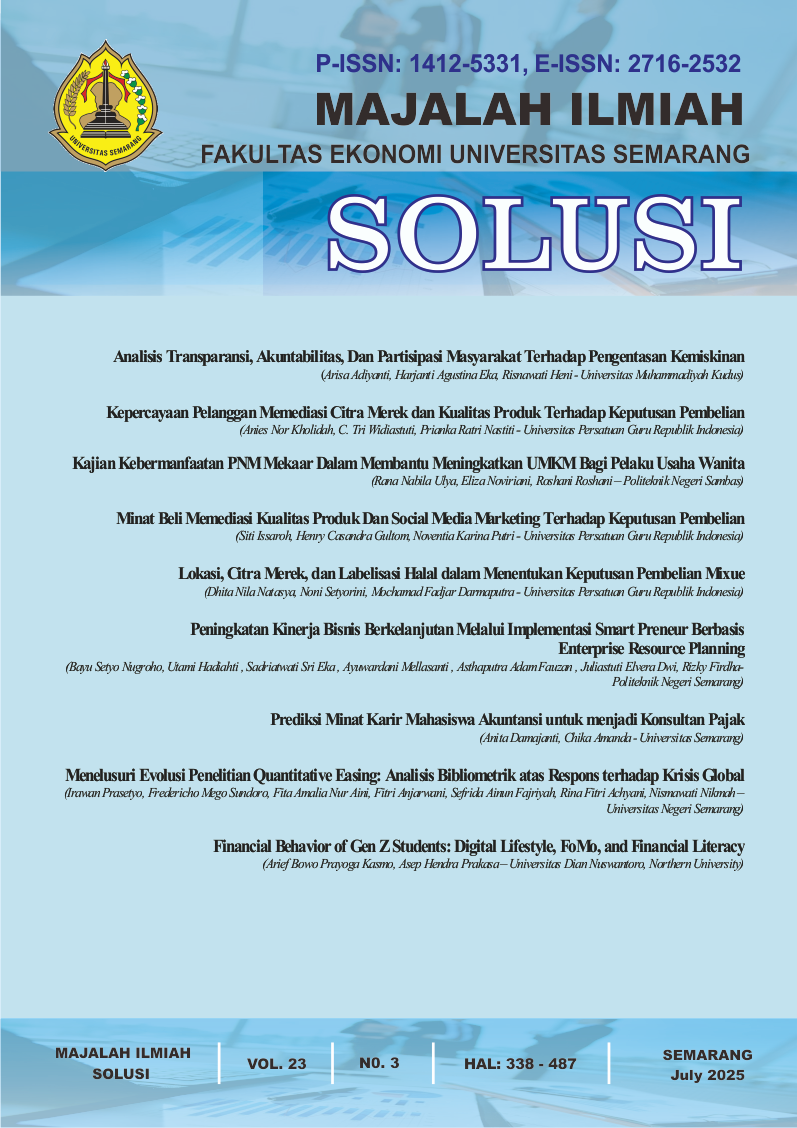
Financial Behavior of Gen Z Students: Digital Lifestyle, FoMo, and Financial Literacy 4491 2859
DOI:
https://doi.org/10.26623/slsi.v23i3.12359Abstract
The financial behavior of Generation Z is now starting to become worrying. Generation Z is considered a generation that is highly skilled at utilizing digital technology in every online shopping activity so that it tends to be consumptive in daily activities. Generation Z is not yet able to manage finances so that it increases consumptive behavior that will be detrimental to finances in the future. This study aims to examine the factors that influence the financial management behavior of Generation Z, especially students. The factors to be studied include financial literacy, digital lifestyle and fear of missing out in influencing financial management behavior. Data processing uses SEM-PLS analysis with SmartPLS Version 3.2.8 as an analytical tool. The population of this study is Generation Z students who are studying in the city of Semarang. The sample of this study is Generation Z who are still students, amounting to 147 people. The results of this study state that financial literacy has a positive significance on the financial behavior of Generation Z, especially students. Meanwhile, the variables of fear of missing out and digital lifestyle have no influence on financial management behavior in Generation Z who are still students. The results also show that financial literacy is an absolute factor that influences the financial behavior of Generation Z students
References
Abdul Gafar, M. H., & Mohd Ali, N. A. (2023). Consumer Behavior: Digital Lifestyle.
Apolo, M., & Kurniawati, M. (2023). Pengaruh Fear Of Missing Out (Fomo) Terhadap Perilaku Konsumtif Penggemar KPOP Remaja Akhir Pada Produk Merchandise KPOP. INNOVATIVE: Journal Of Social Science Research, 3(6), 3847-3858.
Budiono, (2020). Analisis Financial Knowledge, Financial Attitude, Income, Locus Of Control, Financial Management Behavior. vol. 8.
Çalışkan, C. (2021). Sustainable tourism: gen Z?. Journal of multidisciplinary academic tourism, 6(2), 107-115.
Chen, H., & Volpe, R. (2002). Gender Differences in Personal Financial Literacy among College Students. Financial Services Review, 11(3), 289.
Darmawan, A., & Pratiwi, F. A. (2020). Pengaruh Pendidikan Keuangan Keluarga, Pembelajaran Keuangan di Perguruan Tinggi, Sikap Keuangan dan Teman Sebaya Terhadap Literasi Keuangan Mahasiswa. Fokus Bisnis : Media Pengkajian Manajemen Dan Akuntansi, 19(1), 27–37. https://doi.org/10.32639/fokusbisnis.v19i1.499
Fadilah, S. J., & Purwanto, E. (2022). Pengaruh Locus of Control, Perencanaan dean Literasi Keuangan terhadap Perilaku Keuangan UMKM. Al-Kharaj : Jurnal Ekonomi, Keuangan & Bisnis Syariah, 4(5), 1476–1488. https://doi.org/10.47467/alkharaj.v4i5.1003.
Hair, J. F., Risher, J. J., Sarstedt, M., & Ringle, C. M. (2019). When to use and how to report the results of PLS-SEM. In European Business Review (Vol. 31, Issue 1, pp. 2–24). Emerald Group Publishing Ltd. https://doi.org/10.1108/EBR-11-2018-0203.
Hasan, R., Ashfaq, M., Parveen, T., & Gunardi, A. (2023). Financial inclusion – does digital financial literacy matter for women entrepreneurs? International Journal of Social Economics, 50(8), 1085–1104. https://doi.org/10.1108/IJSE-04-2022-0277.
Irawati, R., & Kasemetan, S. L. (2023). Literasi keuangan, gaya hidup, sikap keuangan terhadap perilaku pengelolaan keuangan mahasiswa. Jurnal EMA, 8(1), 32-42.
Ivantchev, B., & Ivantcheva, M. (2023). FOMO effect: social media and online traders. Journal of Management and Financial Sciences, 16(48), pp. 59-74.
K. Laturette, L. P. Widianingsih, L. Subandi.(2021). Literasi Keuangan Pada Generasi Z. jpak, vol. 9(1), 131–139, doi: 10.26740/jpak.v9n1.p131-139.
Kanda, A. S., & Yanti, A. D. (2024). Pengaruh FOMO Terhadap Penggunaan Pinjaman Online Studi Kasus: Mahasiswa Universitas Teknologi Digital. Jurnal Ilmiah Sain Dan Teknologi, 2, 221-232.
Kadarningsih, V. Oktavia, T. R. F. Falah, and Y. S. Sari. (2021). Profitability As Determining Factor to Anticipate Company Bankruptcy. EEA, vol. 39(12). doi: 10.25115/eea.v39i12.6171.
Kasoga, P. S., & Tegambwage, A. G. (2022). Psychological traits and investment decisions: the mediation mechanism of financial management behavior – evidence from the Tanzanian stock market. Journal of Money and Business, 2(2), 213–227. https://doi.org/10.1108/jmb-05-2022-0028.
Khoirunnisa, R. A., & Purnamasari, P. E. (2024). Literasi Keuangan Memoderasi Hubungan FoMO, Love of Money, dan Self Control terhadap Pengelolaan Keuangan Pribadi. Jurnal E-Bis, 8(2), 724-739.
Kushwaha, B. P. (2021). Paradigm shift in traditional lifestyle to digital lifestyle in Gen Z: a conception of consumer behaviour in the virtual business world. International Journal of Web Based Communities, 17(4), 305-320.
Lučić, A., Uzelac, M., & Previšić, A. (2021). The power of materialism among young adults: exploring the effects of values on impulsiveness and responsible financial behavior. Young Consumers, 22(2), 254–271. https://doi.org/10.1108/YC-09-2020-1213.
Ma, K., & Fang, B. (2023). Exploring Generation Z’s expectations at future work: the impact of digital technology on job searching. European Journal of Training and Development. https://doi.org/10.1108/EJTD-05-2023-0076.
Mulyadi, N. Subagio, and R. Riyadi. (2022).Kemampuan Pengelolaan Keuangan Mahasiswa Pendidikan Ekonomi Universitas Mulawarman, escs, vol. 2(1), 25–32, doi: 10.30872/escs.v2i1.1186.
Mustikasari, A., & Septina, F. (2023). Pengaruh Literasi Keuangan, Impulsive Buying, Dan Pengendalian Diri Terhadap Pengelolaan Keuangan Pribadi Mahasiswa Jurusan Akuntansi Universitas Ciputra. Jae (Jurnal Akuntansi Dan Ekonomi), 8(2), 48–54. https://doi.org/10.29407/jae.v8i2.20179.
Nabila, D. A., Masitoh, U., & Aprillianti, V. (2023). Dampak Media Sosial akan Gaya Hidup Mahasiswa Universitas Tulungagung. Governance, JKMP (Governance, Jurnal Kebijakan & Manajemen Publik), 13(1), 8-16.
Nirmala, N., Muntahanah, S., & Achadi, A. (2022). Pengaruh Literasi Keuangan Terhadap Perilaku Keuangan Mahasiswa Feb Universitas Wijayakusuma Purwokerto. Monex: Journal of Accounting Research, 11(01), 1-9.
Nobriyani, A. P., & Haryono, N. A. (2022). Faktor-faktor yang memengaruhi financial management behavior pada keluarga tki di kabupaten ponorogo. Jurnal Ilmu Manajemen (JIM), 7(3), 841-856.
Poyoi, P., Gassiot-Melian, A., & Coromina, L. (2024). Generation Z and Millennials’ food-sharing behaviour: a cross-generational analysis of motivations, satisfaction and behavioural intention. British Food Journal, 126(13), 207–225. https://doi.org/10.1108/BFJ-10-2023-0899.
Przybylski, A. K., Murayama, K., Dehaan, C. R., & Gladwell, V. (2013). Motivational, emotional, and behavioral correlates of fear of missing out. Computers in Human Behavior, 29(4), 1841–1848. https://doi.org/10.1016/J.CHB.2013.02.014.
Septyaningtyas, R.D., Laely, N., Kadiri, U., Selomangkleng No, J., Kota Kediri, M., & Timur, J. (2024). The Effect of Lifestyle, FoMO, and Self Control On Personal Financial Planning (Vol. 2).
Rungruangjit, W., & Charoenpornpanichkul, K. (2024). What motivates consumers’ continued usage intentions of food delivery applications in post-COVID-19 outbreak? Comparing Generations X, Y and Z. Journal of Asia Business Studies, 18(1), 224–251. https://doi.org/10.1108/JABS-06-2023-0234.
Safitri, G., Prastika, N. D., & Handayani, N. (2024). The Influence of Conformity and Hedonistic Lifestyle With Consumptive Behavior. Eduvest-Journal of Universal Studies, 4(11), pp.1-11, doi : https://doi.org/10.59188/eduvest.v4i11.44734
Sakinah, N., Martha Darman, D., Arfah, L., & Al-Kifayah Riau, S. (2023). Pengenalan Literasi Keuangan dan Pengendalian Personal Financial Planning untuk Generasi Z. Jurnal Pengabdian Dan Pengembangan Masyarakat, 1, 16–24.
Sada, Y. M. V. K. (2022). Pengaruh Literasi Keuangan, Gaya Hidup dan Lingkungan Sosial Terhadap Perilaku Keuangan Mahasiswa: Pengaruh Literasi Keuangan, Gaya Hidup dan Lingkungan Sosial Terhadap Perilaku Keuangan Mahasiswa. Jurnal Literasi Akuntansi, 2(2), 86-99.
T. Fungky, T. P. Sari, and V. F. Sanjaya. (2022). Pengaruh Gaya Hidup Serta Literasi Keuangan Terhadap Perilaku Konsumtif Generasi Z Pada Masa Pandemi,” Manage Account Res Econ Entrep, vol. 2, no. 1, pp. 82–98, doi: 10.46306/vls.v2i1.71.
Williams, A., & Hodges, N. (2022). Adolescent Generation Z and sustainable and responsible fashion consumption: exploring the value-action gap. Young Consumers, 23(4), 651–666. https://doi.org/10.1108/YC-11-2021-1419.
Xi, Y., Huo, J., Zhao, X., Jiang, Y., & Yang, Q. (2022). The effects of fear of missing out on social media posting preferences. European Journal of Marketing, 56(12), 3453–3484. https://doi.org/10.1108/EJM-10-2021-0814.
Yulianto, M. D., Anggraeni, M. D., Alviasari, A., Wicaksono, M. A., Maya, M., Amelia, R., & Rozak, R. W. A. (2024). Pengaruh fear of missing out (FoMO) di media sosial terhadap kesehatan keuangan generasi Z. Jurnal Bisnis Kreatif dan Inovatif, 2(2), pp.80-88.
Downloads
Published
Issue
Section
License
Copyright (c) 2025 Dian Prawitasari, Ana Kadarningsih, Mubashir Ahmad

This work is licensed under a Creative Commons Attribution 4.0 International License.
The author who will publish the manuscript at Solusi : Journal of Solusi, agree to the following terms:
|












 This work is licensed under a