ISSN
Online: 2621-4105Journal History
Jurnal USM Law Review (JULR) was first published in May 2018 by the Master of Law Program, Universitas Semarang. Initially, the journal was published biannually in May and November. Since Volume 4, JULR has consistently published up to 29 articles per issue.
Since Volume 6 (2023), JULR has adjusted its publication frequency to three issues per year, published in April, August, and December. In Volume 7 (2024), the journal established a maximum limit of 35 articles per issue. However, an exception was applied to the December issues, namely Volume 7 Issue 3, which published 62 articles, and Volume 8 Issue 3, which published 90 articles. This policy was adopted in response to a significant surge in manuscript submissions that had successfully passed the peer-review process and were deemed suitable for publication toward the end of the year. The increased number of articles in the December issues was intended to manage the publication backlog and minimize authors’ waiting time, without compromising academic standards or the quality of the editorial process. This adjustment was contextual and temporary, while the maximum limit of 35 articles remains applicable to regular issues.
JULR applied an article publication fee of IDR 750,000 per manuscript. Subsequently, starting from Volume 8 Issue 2 (2025), the publication fee was adjusted to IDR 1,500,000 or equivalent to USD 100. This adjustment was implemented as part of the journal’s management policy to support operational sustainability and to enhance the quality of the publication process.
Starting in 2026, commencing from Volume 9 Issue 1, JULR has adopted a quarterly publication schedule, with issues published in March, June, September, and December. This adjustment follows the ISSN Decree Number 0005.26214105/JI.3.1/SK.ISSN/2018.06, which formalizes the change in publication frequency to four issues per year.
JULR publishes peer-reviewed scholarly works in the fields of Criminal Law, Civil Law, Constitutional Law, International Law, Administrative Law, Islamic Law, Business Law, Medical Law, Environmental Law, Adat Law, Agrarian Law, and Legal Philosophy. Each issue features selected research articles and conceptual or doctrinal review articles that advance legal scholarship at both national and international levels.
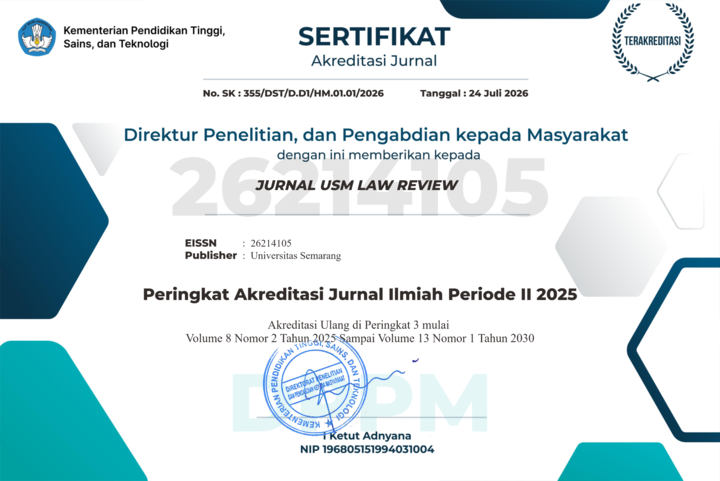
JULR continues to develop as a nationally reputable legal journal. This is evidenced by its accreditation and indexing in the Science and Technology Index SINTA 3, as stipulated by the Decree of the Director General of Research and Development of the Ministry of Research, Technology, and Higher Education of the Republic of Indonesia Number 79/E/KPT/2023. In addition, JULR continuously strengthens its editorial quality and scholarly network by involving editors and reviewers from various higher education institutions at both national and international levels.
Since its inception, JULR has fully implemented the Open Journal Systems (OJS) platform, and all submitted manuscripts undergo rigorous peer review by legal scholars and experts in their respective fields. The journal is committed to maintaining high academic standards through transparent editorial management and quality assurance mechanisms. It serves as a platform for disseminating original, high-quality legal research that advances legal scholarship at both national and international levels.







 Citedness in Scopus