Reconstructing PMN Accountability in Indonesian State-Owned Enterprise Governance 141 95
DOI:
https://doi.org/10.26623/julr.v9i3.14609Keywords:
Accountability, State Finance, State Capital Participation, SOEsAbstract
This study aims to analyze the legal status of State Capital Participation (Penyertaan Modal Negara—PMN) granted to PT Permodalan Nasional Madani (PT PNM) and to formulate an integrated accountability framework capable of reconciling the normative conflict between state finance law and corporate law in Indonesian State-Owned Enterprises (SOEs). Existing studies have predominantly examined PMN from economic, asset management, or criminal law perspectives, leaving unresolved the legal uncertainty concerning separated state assets, directors’ liability, and the relationship between constitutional accountability and corporate governance. This research employs a normative juridical method using statutory, conceptual, and case approaches, with legal materials analyzed through doctrinal reasoning and systematic legal interpretation. The findings reveal that PMN should be understood as a hybrid legal institution that constitutionally remains part of state finance while being operationally managed under corporate governance principles, including separate legal personality, fiduciary duty, and the Business Judgment Rule. The novelty of this study lies in the formulation of a hybrid accountability framework integrating administrative accountability, fiduciary-based civil liability, and criminal liability as a proportional premium remedium, thereby establishing clear legal boundaries between legitimate business risk and unlawful management of state capital. This study contributes theoretically to the harmonization of state finance law and corporate governance, while providing a normative framework for strengthening legal certainty, regulatory coherence, and sustainable governance of Indonesian SOEs.
References
Abimanyu, Y, and R. Rokhim. “The Effect Of State Capital Participation On The Financial And Non-Financial Performance Of State-Owned Enterprises And Other Institutions.” Cakrawala Repositori IMWI 6, no. 6 (2023): 2539–2557. https://doi.org/10.52851/cakrawala.v6i6.556.
Adhitya, Wisnu Purna, and Akhmad Solikin. “The Impact of Government Investment in the Form of Additional State Capital Participation on the Financial Performance of State-Owned Enterprises.” Jurnal Bisnis Dan Akuntansi Unsurya 10, no. 1 (2025): 1–19. https://doi.org/10.35968/jbau.v10i1.1424.
Afdhali, Dino Rizka. “The Ideality of Law Enforcement Reviewed from the Perspective of Legal Purpose Theory.” Collegium Studiosum Journal 6, no. 2 (2023): 555–561. https://doi.org/10.56301/csj.v6i2.1078.
Atikah, Januwianti. “A Legal Study on Capital Ownership in the Transformation of State-Owned Enterprises into Private-Owned Enterprises.” Lex Crimen 5, no. 3 (2016): 1–13. https://doi.org/https://www.neliti.com/id/publications/3436/kajian-hukum-tentang-kepemilikan-modal-terhadap-badan-usaha-milik-negara-menjadi.
Fathyah, Nuzul, Tintin Sri, and Nurmita Sari. “State Capital Participation in State-Owned Enterprises within Public Corporations (Perum): A Study on Perum Perhutani.” Journal of Business Administration Economic & Entrepreneurship 1, no. 1 (2019): 16–26. https://jurnal.stialan.ac.id/index.php/jbest/article/view/111.
Firzada, Mohammad Iqbal. “State Capital Participation Policy for the Recovery of MSMEs.” Kementerian Keuangan, 2020. https://www.djkn.kemenkeu.go.id/artikel/baca/13216/Kebijakan-Penyertaan-Modal-Negara-untuk-Pemulihan-.
Halley, G. “The Criminal Liability of Artificial Intelligence Entities – From Science Fiction to Legal Social Control.” Akron Intellectual Property Journal 4, no. 2 (2010): 182. https://doi.org/10.2139/ssrn.1564096.
Herman. “Abuse of Authority in Capital Participation Activities of Village-Owned Enterprises Which Implicated Criminal Acts of Corruption.” Halu Oleo Legal Research 5, no. 1 (2023): 234–249. https://doi.org/10.33772/holresch.v5i1.336.
Hidayatussalam. “Legal Analysis Of State Financial Loss In State-Owned Business Entity (BUMN).” Jurnal Pendidikan Dan Konseling 4, no. 5 (2022): 2693–2701. https://doi.org/10.31004/jpdk.v4i5.7019.
Josephine, Ingrid, and Suparjo. “The Authority to Transfer Land Rights Derived from State Capital Participation (PMN) in Persero.” Journal of Social Sciences and Education 6, no. 2 (2022): 3683–3695. http://dx.doi.org/10.58258/jisip.v6i2.2929.
Mada, A, and T. W Dati. “Analysis of the Effect of State Capital Participation, Solvency, Liquidity, and Asset Growth on the Financial Performance of State-Owned Enterprises.” IDEI: Jurnal Ekonomi & Bisnis 3, no. 2 (2022): 114–128. https://doi.org/10.38076/ideijeb.v3i2.140.
Mahesa, Agni. “Legal Aspects of the Regulation of State Capital Participation in International Financial Institutions.” Jurnal Reformasi Hukum 19, no. 2 (2016): 243–265. https://doi.org/10.46257/jrh.v20i2.10.
Nanda, Akhmadi Heru and Putu. “Analysis of the Benefits of State Capital Participation in the Bali Provincial Rural Electricity Infrastructure Development Program.” Journal of Economic Development 25, no. 1 (2021): 8–22. https://doi.org/10.26593/be.v25i1.5114.8-22.
Pratama, Akhdi Martin. “This Year, PNM Receives a Capital Injection of Rp 2.5 Trillion from the Government.” Kompas.com, 2020. https://money.kompas.com/read/2020/12/10/145134126/tahun-ini-pnm-dapat-suntikan-dana-rp-25-triliun-dari-pemerintah.
Prayogo, Leonardus A. “Mechanism for Converting Debt into Equity Participation as an Effort to Resolve State Receivables in the State-Owned Food Holding Company.” Acta Diurnal 7, no. 1 (2023): 133–145. https://doi.org/10.23920/acta.v7i1.1690.
Putra, Widhya Mahendra. “The Mechanism of State Capital Participation in State-Owned Enterprises With or Without the Approval of the House of Representatives from the Perspective of Financial Law.” PDRH Soediman 1, no. 1 (2019): 1–13. https://doi.org/10.30641/dejure.2019.V19.385-403.
Rahardjo, Satjipto. Legal Sciences. Bandung: Citra Aditya Bhakti, 2006.
RH, Mutia, Aisha Sugiharti, Dewi Kania, and Tsuraya Ghefiranisa. “Regional Government Capital Participation in Regional-Owned Enterprises: The Shift of Legal Regimes and Challenges in Regional Asset Governance.” Widya Yuridika: Jurnal Hukum 8, no. 3 (2025): 739–754. https://doi.org/10.31328/wy.v8i3.7044.
Wijaya, Ivan Satria. “The Accountability of the Management of State-Owned Enterprises for State Financial Losses in the Management of Persero.” Scientific Journal of Students 4, no. 2 (2015): 1–14. https://journal.ubaya.ac.id/index.
Downloads
Published
Issue
Section
License
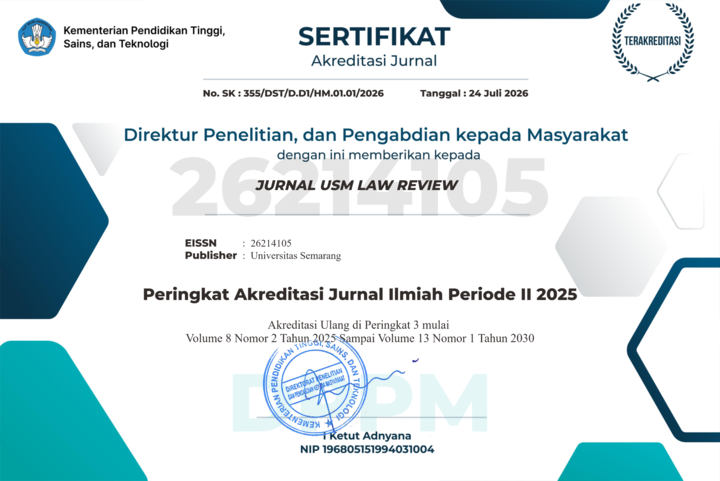
Copyright (c) 2026 JURNAL USM LAW REVIEW

This work is licensed under a Creative Commons Attribution 4.0 International License.

The journal holds the copyright for each article published with work licensed simultaneously under a Creative Commons Attribution 4.0 International License, which allows others to share the work with an acknowledgment of the authorship and early publication of the work in this journal.







 Citedness in Scopus