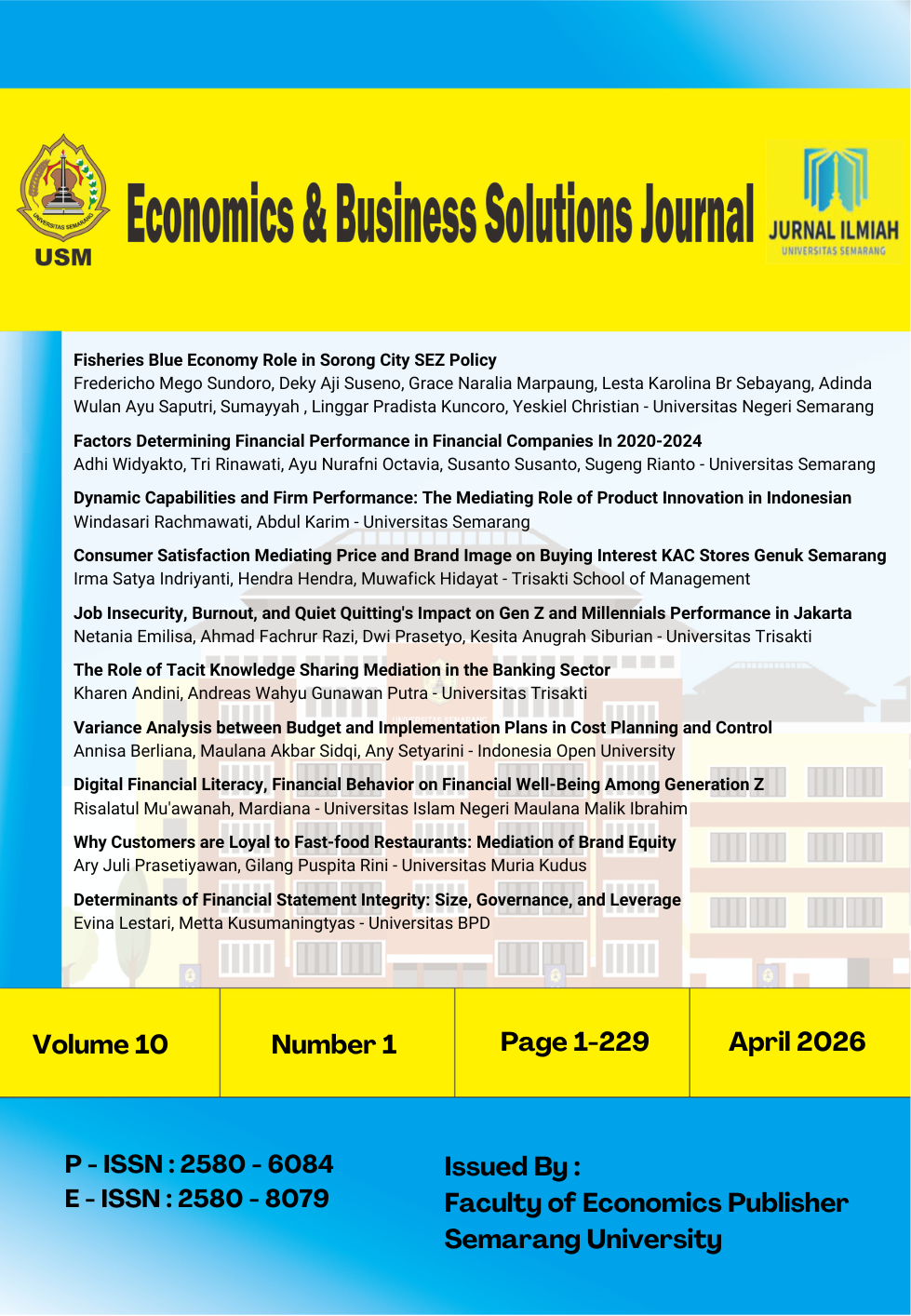
The Role of Tacit Knowledge Sharing Mediation in the Banking Sector 171 156
DOI:
https://doi.org/10.26623/ebsj.v10i1.13448Keywords:
Work Overload, Organizational Trust, Tacit Knowledge Sharing, Innovative Work Behavior, BankingAbstract
This research examines how excessive task demands and institutional trust mechanisms influence innovative work behavior, positioning tacit knowledge sharing as an intervening construct among banking employees in Central Jakarta. A quantitative correlational framework with hypothesis verification was applied, whereby empirical data were obtained through structured questionnaires employing Likert scaling (1-5), administered to 260 permanent staff from Bank X and Bank Y via purposive sampling. Data processing involved descriptive statistical assessment and Structural Equation Modeling (SEM) via AMOS, satisfying established goodness-of-fit standards. Empirical outcomes demonstrated that work overload conditions and organizational trust significantly influence tacit knowledge sharing practices, while tacit knowledge sharing itself significantly predicts innovative work behavior. Furthermore, work overload and organizational trust were empirically validated as impacting innovative work behavior through both direct pathways and indirect pathways mediated by tacit knowledge sharing. These results suggest managerial implications including regulating workload distribution proportionally, cultivating organizational trust through equitable communicative practices, and reinforcing tacit knowledge sharing norms through best-practice exchange platforms, mentoring initiatives, and communities of practice. Future investigations should integrate additional explanatory variables (innovation climate, digital leadership orientation) and broaden empirical scope to alternative banking entities or service-based industries for more exhaustive understanding of innovative work behavior dynamics within digitally driven environments
References
Aisyah Yudhawan, S., & Herachwati, N. (2025). A Systematic Literature Review: the Effect of Tacit Knowledge Sharing on Employee Innovation. Journal La Sociale, 6(5), 1580–1889. https://doi.org/10.37899/journal-la-sociale.v6i5.2268
Alomran, A. M., Ahmed, T. S. A., & Kassem, A. M. (2024a). Impact of organizational trust on organizational commitment: the moderating effect of national identity. Cogent Social Sciences, 10(1). https://doi.org/10.1080/23311886.2024.2309712
Alomran, A. M., Ahmed, T. S. A., & Kassem, A. M. (2024b). Impact of organizational trust on organizational commitment: the moderating effect of national identity. Cogent Social Sciences, 10(1). https://doi.org/10.1080/23311886.2024.2309712
Aryani, O., Yazdani, H., & Ramezan, M. (2025). Identifying and explaining the mechanism of tacit knowledge sharing among University of Tehran employees in the development of successors. Strategic Management of Organizational Knowledge. https://doi.org/10.47176/SMOK.2025.1881
Bakker, A. B., & Demerouti, E. (2017). Job demands-resources theory: Taking stock and looking forward. Journal of Occupational Health Psychology, 22(3), 273–285. https://doi.org/10.1037/OCP0000056
Barriga Medina, H. R., Campoverde Aguirre, R., Coello-Montecel, D., Ochoa Pacheco, P., & Paredes-Aguirre, M. I. (2021). The Influence of Work–Family Conflict on Burnout during the COVID-19 Pandemic: The Effect of Teleworking Overload. International Journal of Environmental Research and Public Health 2021, Vol. 18, Page 10302, 18(19), 10302. https://doi.org/10.3390/IJERPH181910302
Booth-Ledoux, S. M., Matthews, R. A., & Wayne, J. H. (2020). Testing a resource-based spillover-crossover-spillover model: Transmission of social support in dual-earner couples. Journal of Applied Psychology, 105(7), 732–747. https://doi.org/10.1037/APL0000460
Darathi, J., & Sowmya, G. (2025). Mental spillover in IT workplace: overthinking and organizational support in the work-family conflict and incivility link among employees in Chennai. International Journal of Sociology and Social Policy, 1–18. https://doi.org/10.1108/IJSSP-06-2025-0348
Delisle, M., Pradarelli, J. C., Panda, N., Koritsanszky, L., Sonnay, Y., Lipsitz, S., Pearse, R., Harrison, E. M., Biccard, B., Weiser, T. G., & Haynes, A. B. (2020). Variation in global uptake of the Surgical Safety Checklist. British Journal of Surgery, 107(2), e151–e160. https://doi.org/10.1002/BJS.11321;WGROUP:STRING:PUBLICATION
Demerouti, E. (2025). Job demands-resources and conservation of resources theories: How do they help to explain employee well-being and future job design? Journal of Business Research, 192. https://doi.org/10.1016/j.jbusres.2025.115296
Enwereuzor, I. K. (2021). Diversity climate and workplace belongingness as organizational facilitators of tacit knowledge sharing. Journal of Knowledge Management, 25(9), 2178–2195. https://doi.org/10.1108/JKM-10-2020-0768
Fatimah, T., & Gunawan, A. W. (2023). Analisis pengaruh work life balance dan person job fit terhadap affective organizational commitment. Jurnal Ilmiah Bisnis dan Ekonomi Asia, 17(1), 75–89. https://doi.org/10.32812/jibeka.v17i1.1296
Ganewatta, G. K. H., & Hiroshima, N. L. D. H. (2023). Impact of work overload as a job stressor on employees intention to leave: The mediating effect of work-family conflict in a Sri Lankan apparel sector organisation. Pressacademia. https://doi.org/10.17261/PRESSACADEMIA.2023.1822
Ganguly, A., Talukdar, A., & Chatterjee, D. (2019). Evaluating the role of social capital, tacit knowledge sharing, knowledge quality and reciprocity in determining innovation capability of an organization. Journal of Knowledge Management, 23(6), 1105–1135. https://doi.org/10.1108/JKM-03-2018-0190
Hair, J. F. ., Hult, G. T. M. ., Ringle, C. M. ., & Sarstedt, Marko. (2017). A primer on partial least squares structural equation modeling (PLS-SEM). Sage.
Horowitz-Kraus, T., Rosch, K., Fotang, J., Mostofsky, S. H., Schlaggar, B. L., Pekar, J., Taran, N., & Farah, R. (2023). Fluent contextual reading is associated with greater synchronization of the visual and auditory networks, fluent reading and better speed of processing in children with dyslexia. Cortex, 168, 62–75. https://doi.org/10.1016/j.cortex.2023.07.007
Huie, C. P., Cassaberry, T., & Rivera, A. K. (n.d.). The Impact of Tacit Knowledge Sharing on Job Performance. International Journal on Social and Education Sciences, 2(1), 2020.
Khairy, H. A., Baquero, A., & Al-Romeedy, B. S. (2023). The Effect of Transactional Leadership on Organizational Agility in Tourism and Hospitality Businesses: The Mediating Roles of Organizational Trust and Ambidexterity. Sustainability 2023, Vol. 15, Page 14337, 15(19), 14337. https://doi.org/10.3390/SU151914337
Kmieciak, R. (2020). Trust, knowledge sharing, and innovative work behavior: empirical evidence from Poland. European Journal of Innovation Management. https://doi.org/10.1108/EJIM-04-2020-0134/FULL/PDF
Kucharska, W., & Erickson, G. S. (2023). Tacit knowledge acquisition & sharing, and its influence on innovations: A Polish/US cross-country study. International Journal of Information Management, 71. https://doi.org/10.1016/j.ijinfomgt.2023.102647
Kurniawati, F., Fikaris, M. F., Eryani, I. S., Rohendi, A., & Wahyudi, B. (2023). The Effect of Work-load, Burnout, and Work Motivation on Nurse Performance. Jurnal Aplikasi Manajemen, 21(4), 915–927. https://doi.org/10.21776/ub
Mahipalan, M., & Sheena, S. (2019). Workplace spirituality, psychological well-being and mediating role of subjective stress: A case of secondary school teachers in India. International Journal of Ethics and Systems, 35(4), 725–739. https://doi.org/10.1108/IJOES-10-2018-0144/FULL/PDF
Maurseth, P. B., & Svensson, R. (2020). The Importance of Tacit Knowledge: Dynamic Inventor Activity in the Commercialization Phase. Research Policy, 49(7), 104012. https://doi.org/10.1016/J.RESPOL.2020.104012
Montani, F., Boudrias, J. S., & Pigeon, M. (2020). Employee recognition, meaningfulness and behavioural involvement: test of a moderated mediation model. International Journal of Human Resource Management, 31(3), 356–384. https://doi.org/10.1080/09585192.2017.1288153
Panda, T., & T.N.V.R.L, S. (2025). From Strain to Spark: Examining the Detachment-Flexibility-Innovation Mechanism in IT Workplaces. Global Journal of Flexible Systems Management, 26(4), 903–933. https://doi.org/10.1007/S40171-025-00468-6
Ramos, H. M., Mustafa, M., & Zainal Badri, S. K. (2025). Job and work context elements in fostering employee creative behavior: exploring the moderating role of work passion. Journal of Management & Organization, 31(3), 1263–1282. https://doi.org/10.1017/JMO.2022.52
Shahzad, Q., Shah, B., Waseem, M., & Bilal, H. (2020). An Empirical Analysis of Work Overload, Organizational Commitment and Turnover Intentions among Employees of Banking Sector. Journal of Business and Social Review in Emerging Economies, 6(2), 781–788. https://doi.org/10.26710/jbsee.v6i2.1225
Stoian, M. C., Tardios, J. A., & Samdanis, M. (2024). The knowledge-based view in international business: A systematic review of the literature and future research directions. International Business Review, 33(2). https://doi.org/10.1016/j.ibusrev.2023.102239
Utomo, A. A., Maulida, M., & Musa, S. (2023). Organizational Inertia, Digital Capabilities, Digital Transformation, and Firm Competencies. The South East Asian Journal of Management, 17(1), 6. https://doi.org/10.21002/seam.v17i1.1283
Yudhaputri, E. A., Emilisa, N., & Lunarindiah, G. (2021). Differences between generation X and generation Y in job involvement and commitment: A study in event organizer companies. Review of Integrative Business and Economics Research, 10(Supplementary Issue 3), 146–159.
Zhong, C., Franklin, M., Wang, S. S., & Longcore, T. (2022). Zhong et al. Respond to “There’s No Place Like Home.” American Journal of Epidemiology, 191(9), 1544. https://doi.org/10.1093/AJE/KWAC085
Downloads
Published
Issue
Section
License
Copyright (c) 2026 Kharen Andini, Andreas Wahyu Gunawan Putra

This work is licensed under a Creative Commons Attribution 4.0 International License.
The journal holds the copyright for each article published with work licensed simultaneously under a Creative Commons Attribution 4.0 International License, which allows others to share the work with an acknowledgment of the authorship and early publication of the work in this journal.








 This work is licensed under a