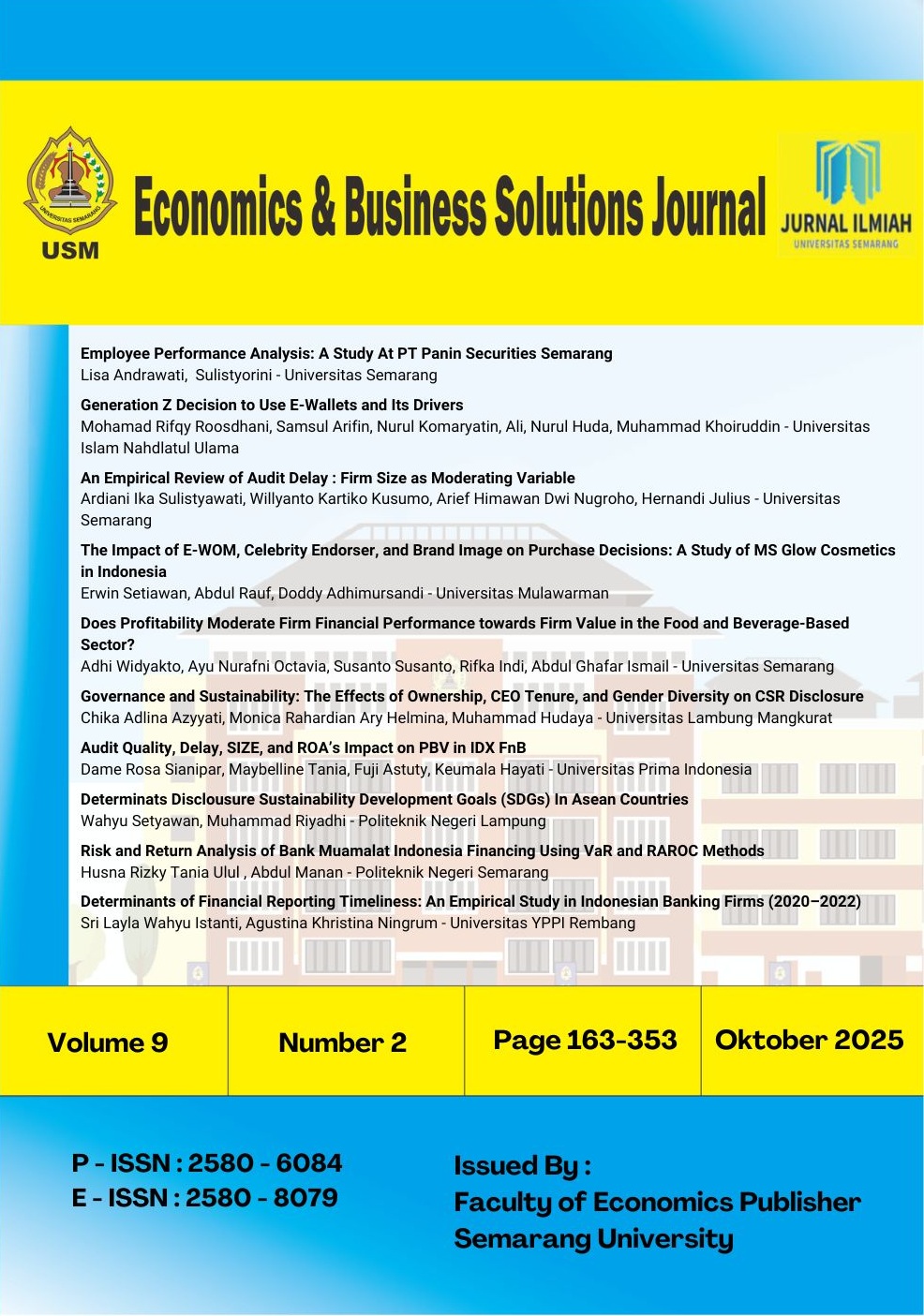
Determinats Disclousure Sustainability Development Goals (SDGs) In Asean Countries 396 211
DOI:
https://doi.org/10.26623/ebsj.v9i2.12777Keywords:
SDGs Disclosure, Global Reporting Initiative, Sustainability Accounting Standards BoardAbstract
This study aims to analyze the impact of the implementation of the Global Reporting Initiative (GRI) and the Sustainability Accounting Standards Board (SASB) on the quality of Sustainable Development Goals (SDGs) disclosure in six ASEAN countries: Indonesia, Malaysia, Thailand, Singapore, Vietnam, and the Philippines. A quantitative approach was employed, utilizing secondary data from sustainability reports for 2022-2023, analyzed using panel data regression with a fixed effects model. The results indicate that both independent variables have a significant positive partial effect on SDGs disclosure. The SASB variable demonstrated a significant influence with an error rate of 14%, while the GRI variable was significant with a 3.7% error rate. These findings indicate that the adoption of specific sustainability reporting standards SASB with its focus on industry-specific material topics and GRI with its comprehensive framework effectively enhances corporate transparency and accountability in achieving sustainable development objectives. This research provides practical implications for policymakers and regulators in the ASEAN region to promote the harmonization and adoption of standardized reporting frameworks to improve the quality of SDGs disclosure, which can ultimately attract investment, create jobs, and improve societal welfare. The originality of the study lies in its application of the Sustainability Maturity Model theoretical framework and the use of panel data regression analysis to investigate the complex interactions between these variables within the ASEAN context.
References
Abeysekera, I. (2022). A framework for sustainability reporting. Sustainability Accounting, Management and Policy Journal, 13(6), 1386–1409. https://doi.org/10.1108/SAMPJ-08-2021-0316
Ahyar, H., Maret, U. S., Andriani, H., Sukmana, D. J., Mada, U. G., Hardani, S.Pd., M. Si., Nur Hikmatul Auliya, Grad. Cert. B., Helmina Andriani, M. Si., Fardani, R. A., Ustiawaty, J., Utami, E. F., Sukmana, D. J., & Istiqomah, R. R. (2020). Buku Metode Penelitian Kualitatif & Kuantitatif (Issue March).
Aifuwa, H. O. (2020). Sustainability Reporting And Firm Performance In Developing Climes: A Review Of Literature. Copernican Journal of Finance & Accounting, 9(1), 9. https://doi.org/10.12775/cjfa.2020.001
Amaliyah, A. N., & Andayani, W. (2022). Pengungkapan Sdgs Pada Laporan Keberlanjutan Pt Petrokimia Gresik Berdasarkan Standar Global Reporting Initiative (GRI) Periode 2018-2020. Tema, 23(2), 108–119. https://doi.org/10.21776/tema.23.2.108-119
Amorós Molina, Á., Helldén, D., Alfvén, T., Niemi, M., Leander, K., Nordenstedt, H., Rehn, C., Ndejjo, R., Wanyenze, R., & Biermann, O. (2023). Integrating the United Nations sustainable development goals into higher education globally: a scoping review. In Global Health Action (Vol. 16, Issue 1). Taylor and Francis Ltd. https://doi.org/10.1080/16549716.2023.2190649
Ardiansyah, Risnita, & Jailani, M. S. (2023). Teknik Pengumpulan Data Dan Instrumen Penelitian Ilmiah Pendidikan Pada Pendekatan Kualitatif dan Kuantitatif. Jurnal IHSAN : Jurnal Pendidikan Islam, 1(2), 1–9. https://doi.org/10.61104/ihsan.v1i2.57
Asuquo, A. I., Temitayo, D. E., & Raphael, O. U. (2018). The Effect of Sustainability Reporting on Corporate Performance of Selected Quoted Brewery Firms in Nigeria ECO-FRIENDLY/ENVIRONMENTAL ACCOUNTING View project Corporate Governance View project. International Journal of …, September 2019, 2002–2011.
Aurora L, T., Rehanil A, D., & Solikhin, A. (2021). Pengaruh Pengungkapan Corporate Social Responsibility Terhadap Nilai Perusahaan Dengan Ukuran Perusahaan Sebagai Variabel Moderating. Jurnal Akuntansi & Keuangan Unja, 6(1), 10–17. https://doi.org/10.22437/jaku.v6i1.13165
Bananuka, J., Nkundabanyanga, S. K., Kaawaase, T. K., Mindra, R. K., & Kayongo, I. N. (2022). Sustainability performance disclosures: the impact of gender diversity and intellectual capital on GRI standards compliance in Uganda. Journal of Accounting in Emerging Economies, 12(5), 840–881. https://doi.org/10.1108/JAEE-09-2021-0301
Bebbington, J., & Unerman, J. (2020). Advancing research into accounting and the UN Sustainable Development Goals. Accounting, Auditing and Accountability Journal, 33(7), 1657–1670. https://doi.org/10.1108/AAAJ-05-2020-4556
Bose, S., Khan, H. Z., & Bakshi, S. (2024). Determinants and consequences of sustainable development goals disclosure: International evidence. Journal of Cleaner Production, 434. https://doi.org/10.1016/j.jclepro.2023.140021
Busco, C., Consolandi, C., Eccles, R. G., & Sofra, E. (2020). A Preliminary Analysis of SASB Reporting: Disclosure Topics, Financial Relevance, and the Financial Intensity of ESG Materiality. Journal of Applied Corporate Finance, 32(2), 117–125. https://doi.org/10.1111/jacf.12411
Chankseliani, M., & McCowan, T. (2021). Higher education and the Sustainable Development Goals. In Higher Education (Vol. 81, Issue 1). Springer Science and Business Media B.V. https://doi.org/10.1007/s10734-020-00652-w
de Villiers, C., La Torre, M., & Molinari, M. (2022). The Global Reporting Initiative’s (GRI) past, present and future: critical reflections and a research agenda on sustainability reporting (standard-setting). Pacific Accounting Review, 34(5), 728–747. https://doi.org/10.1108/PAR-02-2022-0034
Dei, D. G. J., Kankam, P., Anane-Donkor, L., Peasah, T. E., & Puttick, C. P. (2023). Strategies for enrolment management in private universities in Ghana during the COVID-19 pandemic. International Journal of Educational Research Open, 5. https://doi.org/10.1016/j.ijedro.2023.100294
Dissanayake, D., Tilt, C., & Qian, W. (2019). Factors influencing sustainability reporting by Sri Lankan companies. Pacific Accounting Review, 31(1), 84–109. https://doi.org/10.1108/PAR-10-2017-0085
Elalfy, A., Weber, O., & Geobey, S. (2020). The Sustainable Development Goals (SDGs): a rising tide lifts all boats? Global reporting implications in a post SDGs world. Journal of Applied Accounting Research, 22(3), 557–575. https://doi.org/10.1108/JAAR-06-2020-0116
Elmassah, S., Biltagy, M., & Gamal, D. (2022). Framing the role of higher education in sustainable development: a case study analysis. International Journal of Sustainability in Higher Education, 23(2), 320–355. https://doi.org/10.1108/IJSHE-05-2020-0164
Emalia, D., & Shauki, E. R. (2023). Analisa Krisis Legitimasi dan Pembangunan Berkelanjutan PT Pelindo Bengkulu akibat Konflik Lahan dengan Masyarakat. Owner, 7(2), 1612–1623. https://doi.org/10.33395/owner.v7i2.1399
Ferrero-Ferrero, I., Muñoz-Torres, M. J., Rivera-Lirio, J. M., Escrig-Olmedo, E., & Fernández-Izquierdo, M. Á. (2023). SDG reporting: an analysis of corporate sustainability leaders. Marketing Intelligence and Planning, 41(4), 457–472. https://doi.org/10.1108/MIP-07-2022-0332
Fiechter, P., Hitz, J. M., & Lehmann, N. (2022). Real Effects of a Widespread CSR Reporting Mandate: Evidence from the European Union’s CSR Directive. Journal of Accounting Research, 60(4), 1499–1549. https://doi.org/10.1111/1475-679X.12424
Findler, F., Schönherr, N., Lozano, R., Reider, D., & Martinuzzi, A. (2019). The impacts of higher education institutions on sustainable development: A review and conceptualization. In International Journal of Sustainability in Higher Education (Vol. 20, Issue 1, pp. 23–38). Emerald Group Holdings Ltd. https://doi.org/10.1108/IJSHE-07-2017-0114
Franco, I., Saito, O., Vaughter, P., Whereat, J., Kanie, N., & Takemoto, K. (2019). Higher education for sustainable development: actioning the global goals in policy, curriculum and practice. Sustainability Science, 14(6), 1621–1642. https://doi.org/10.1007/s11625-018-0628-4
Galeazzo, A., Miandar, T., & Carraro, M. (2024). SDGs in corporate responsibility reporting: a longitudinal investigation of institutional determinants and financial performance. Journal of Management and Governance, 28(1), 113–136. https://doi.org/10.1007/s10997-023-09671-y
García-Sánchez, I. M., Aibar-Guzmán, B., Aibar-Guzmán, C., & Somohano-Rodríguez, F. M. (2022). The drivers of the integration of the sustainable development goals into the non-financial information system: Individual and joint analysis of their influence. Sustainable Development, 30(4), 513–524. https://doi.org/10.1002/sd.2246
Girón, A., Kazemikhasragh, A., Cicchiello, A. F., & Panetti, E. (2021). Sustainability Reporting and Firms’ Economic Performance: Evidence from Asia and Africa. Journal of the Knowledge Economy, 12(4), 1741–1759. https://doi.org/10.1007/s13132-020-00693-7
Gutiérrez-Ponce, H. (2023). Sustainability as a strategy base in Spanish firms: Sustainability reports and performance on the sustainable development goals. Sustainable Development, 31(4), 3008–3023. https://doi.org/10.1002/sd.2566
Hamad, S., Lai, F. W., Shad, M. K., Khatib, S. F. A., & Ali, S. E. A. (2023). Assessing the implementation of sustainable development goals: does integrated reporting matter? Sustainability Accounting, Management and Policy Journal, 14(1), 49–74. https://doi.org/10.1108/SAMPJ-01-2022-0029
Hamidov, A., Helming, K., Bellocchi, G., Bojar, W., Dalgaard, T., Ghaley, B. B., Hoffmann, C., Holman, I., Holzkämper, A., & Krzeminska, D. (2018). Impacts of climate change adaptation options on soil functions: A review of European case‐studies. Land Degradation & Development, 29(8), 2378–2389.
Hasdiana, U. (2022). Pengaruh profitabilitas, likuiditas, pertumbuhan perusahaan dan struktur modal terhadap nilai perusahaan pada perbankan yang listing di bei periode 2016-2020. Prosiding seminar nasional Program Studi Magister Manajemen Unismuh Makassar Tema: Peran Penta Helix Dalam Transformasi Digital, 11(1), 1–5.
He, Z., Kuai, L., & Wang, J. (2023). Driving mechanism model of enterprise green strategy evolution under digital technology empowerment: A case study based on Zhejiang Enterprises. Business Strategy and the Environment, 32(1), 408–429. https://doi.org/10.1002/bse.3138
Heras-Saizarbitoria, I., Urbieta, L., & Boiral, O. (2022). Organizations’ engagement with sustainable development goals: From cherry-picking to SDG-washing? Corporate Social Responsibility and Environmental Management, 29(2), 316–328. https://doi.org/10.1002/csr.2202
Herlina, N., & Supriyatin, U. (2021). Amdal Sebagai Instrumen Pengendalian Dampak Lingkungan Dalam Pembangunan Berkelanjutan Dan Berwawasan Lingkungan. Jurnal Ilmiah Galuh Justisi, 9(2), 204. https://doi.org/10.25157/justisi.v9i2.5610
Hummel, K., & Szekely, M. (2022). Disclosure on the Sustainable Development Goals–Evidence from Europe. Accounting in Europe, 19(1), 152–189. https://doi.org/10.1080/17449480.2021.1894347
Juniarti, D., Rusnaini, E., Aulia, R., Andriansyah, R., Widiastuti, S., Sisdianto, E., Islam, U., Raden, N., & Lampung, I. (2023). Peran Akuntansi Keberlanjutan dalam Pengungkapan Corporate Social Responsibility (CSR) pada Praktik Bisnis. Jurnal Manajemen Dan Akuntansi, 1(2), 319–327.
Karyanto, B., & Martiana, R. (2020). Peran Akuntan Dan Perusahaan Menuju Tujuan Pembangunan Berkelanjutan (Sustainable Development Goals / Sdgs) 2030. Jurnal Studia Akuntansi Dan Bisnis (The Indonesian Journal of Management & Accounting), 8(1), 15–30. https://doi.org/10.55171/jsab.v8i1.383
Kasbun, N. F., Teh, B. H., & Ong, T. S. (2016). Sustainability reporting and financial performance of Malaysian public listed companies. Institutions and Economies, 8(4), 78–93.
Khan, I., Fujimoto, Y., Uddin, M. J., & Afridi, M. A. (2023). Evaluating sustainability reporting on GRI standards in developing countries: a case of Pakistan. International Journal of Law and Management, 65(3), 189–208. https://doi.org/10.1108/IJLMA-01-2022-0016
Kücükgül, E., Cerin, P., & Liu, Y. (2022). Enhancing the value of corporate sustainability: An approach for aligning multiple SDGs guides on reporting. Journal of Cleaner Production, 333. https://doi.org/10.1016/j.jclepro.2021.130005
Kumar, K. (2022). Emerging phenomenon of corporate sustainability reporting: Evidence from top 100 NSE listed companies in India. Journal of Public Affairs, 22(1). https://doi.org/10.1002/pa.2368
Kurniadi, Y U., et al. (2022). Pengaruh Pengungkapan Keuangan Berkelanjutan Terhadap Nilai Perusahaan Dengan Profitabilitas Sebagai Variabel Moderasi. Nusantara: Jurnal Ilmu Pengetahuan Sosial, 7(2), 408–420.
Lindawati, A. S. L., & Puspita, M. E. (2015). Corporate Social Responsibility: Implikasi Stakeholder dan Legitimacy Gap dalam Peningkatan Kinerja Perusahaan. Jurnal Akuntansi Multiparadigma, 157–174. https://doi.org/10.18202/jamal.2015.04.6013
Liobikiene, G., Butkus, M., & Matuzevičiute, K. (2019). The contribution of energy taxes to climate change policy in the European Union (EU). Resources, 8(2). https://doi.org/10.3390/resources8020063
Liu, J., Kitamura, Y., & Savelyeva, T. (2022). Building an ‘Ecosystem’ for transforming higher education teaching and learning for sustainability. In Asia Pacific Education Review (Vol. 23, Issue 4, pp. 539–542). Springer Science and Business Media B.V. https://doi.org/10.1007/s12564-022-09794-1
Luque-Vílchez, M., Cordazzo, M., Rimmel, G., & Tilt, C. A. (2023). Key aspects of sustainability reporting quality and the future of GRI. Sustainability Accounting, Management and Policy Journal, 14(4), 637–659. https://doi.org/10.1108/SAMPJ-03-2023-0127
Maione, G. (2023). An energy company’s journey toward standardized sustainability reporting: addressing governance challenges. Transforming Government: People, Process and Policy, 17(3), 356–371. https://doi.org/10.1108/TG-05-2023-0062
Mardika, Wilkinson. (2022). Analisis Pengungkapan Sustainable Development Goals (SDGS) PT. GAS NEGARA Tbk. Tahun 2016-2020 Berdasarkan Standar Global Reporting Initiative (GRI). Diponegoro Journal of Accounting, 11(4), 1–15.
McCowan, T. (2023). The crosscutting impact of higher education on the Sustainable Development Goals. International Journal of Educational Development, 103. https://doi.org/10.1016/j.ijedudev.2023.102945
Michael, J., & Taiye, F. (2019). Value Relevance Of Sustainability Reporting In Nigerian Manufacturing Companies. Journal of Global Accounting Department of Accountancy, 6(2). www.unizikjga.com
Nandy, M., Kuzey, C., Uyar, A., Lodh, S., & Karaman, A. S. (2023). Can CSR mechanisms spur GRI adoption and restore its lost value relevance? Journal of Applied Accounting Research, 24(4), 609–634. https://doi.org/10.1108/JAAR-03-2022-0068
Nicolo’, G., Zampone, G., De Iorio, S., & Sannino, G. (2024). Does SDG disclosure reflect corporate underlying sustainability performance? Evidence from UN Global Compact participants. Journal of International Financial Management and Accounting, 35(1), 214–260. https://doi.org/10.1111/jifm.12194
Nicolò, G., Zanellato, G., Tiron-Tudor, A., & Tartaglia Polcini, P. (2023). Revealing the corporate contribution to sustainable development goals through integrated reporting: a worldwide perspective. Social Responsibility Journal, 19(5), 829–857. https://doi.org/10.1108/SRJ-09-2021-0373
Park, J., & Savelyeva, T. (2022). An interpretive analysis of the 2030 Sustainable Development Goals in Hong Kong public universities. Asia Pacific Education Review, 23(4), 543–558. https://doi.org/10.1007/s12564-022-09777-2
Pizzi, S., Del Baldo, M., Caputo, F., & Venturelli, A. (2022). Voluntary disclosure of Sustainable Development Goals in mandatory non-financial reports: The moderating role of cultural dimension. Journal of International Financial Management and Accounting, 33(1), 83–106. https://doi.org/10.1111/jifm.12139
Putri, R., Desak Nyoman Sri Werastuti, Astuty, E. D., Aulia Fatimah Khairunnisa, Eko Wahyono, & Ni Luh Apriani. (2023). Integrated Reporting: Corporate Strategy Towards Achieving Sustainable Development SDGs. Apollo: Journal of Tourism and Business, 1(2), 64–71. https://doi.org/10.58905/apollo.v1i2.39
Sahib, S. A., Dr, Y., & Sahib, M. (n.d.). The Impact Of Sustainability Accounting Standards On Relevance. https://www.scholarexpress.net
Sebrina, N., Taqwa, S., Afriyenti, M., & Septiari, D. (2023). Analysis of sustainability reporting quality and corporate social responsibility on companies listed on the Indonesia stock exchange. Cogent Business and Management, 10(1). https://doi.org/10.1080/23311975.2022.2157975
Sugiyono. (2010). Metode Penelitian Kombinasi (Mixed Methods). Alfabeta.
Udemba, E. N., Emir, F., & Philip, L. D. (2022). Mitigating poor environmental quality with technology, renewable and entrepreneur policies: A symmetric and asymmetric approaches. Renewable Energy, 189, 997–1006. https://doi.org/10.1016/j.renene.2022.03.060
Useh, U. (2021). Sustainable Development Goals as a Framework for Postgraduate Future Research Following COVID-19 Pandemic: A New Norm for Developing Countries. Higher Education for the Future, 8(1), 123–132. https://doi.org/10.1177/2347631120972064
Van Linh, N., Hung, D. N., & Binh, T. Q. (2022). Relationship between sustainability reporting and firm’s value: Evidence from Vietnam. Cogent Business and Management, 9(1). https://doi.org/10.1080/23311975.2022.2082014
Wang, M., & Zhou, C. (2023). How Does Graduate Training Promote Sustainable Development of Higher Education: Evidence from China’s “Double First-Class” Universities’ Programs. Sustainability (Switzerland), 15(2). https://doi.org/10.3390/su15020944
Whittingham, K. L., Earle, A. G., Leyva-de la Hiz, D. I., & Argiolas, A. (2023). The impact of the United Nations Sustainable Development Goals on corporate sustainability reporting. BRQ Business Research Quarterly, 26(1), 45–61. https://doi.org/10.1177/23409444221085585
Žalėnienė, I., & Pereira, P. (2021). Higher Education For Sustainability: A Global Perspective. Geography and Sustainability, 2(2), 99–106. https://doi.org/10.1016/j.geosus.2021.05.001
Zampone, G., Nicolò, G., Sannino, G., & De Iorio, S. (2024). Gender diversity and SDG disclosure: the mediating role of the sustainability committee. Journal of Applied Accounting Research, 25(1), 171–193. https://doi.org/10.1108/JAAR-06-2022-0151
Downloads
Published
Issue
Section
License
Copyright (c) 2025 Wahyu Setyawan; Muhammad Riyadhi

This work is licensed under a Creative Commons Attribution 4.0 International License.
The journal holds the copyright for each article published with work licensed simultaneously under a Creative Commons Attribution 4.0 International License, which allows others to share the work with an acknowledgment of the authorship and early publication of the work in this journal.








 This work is licensed under a