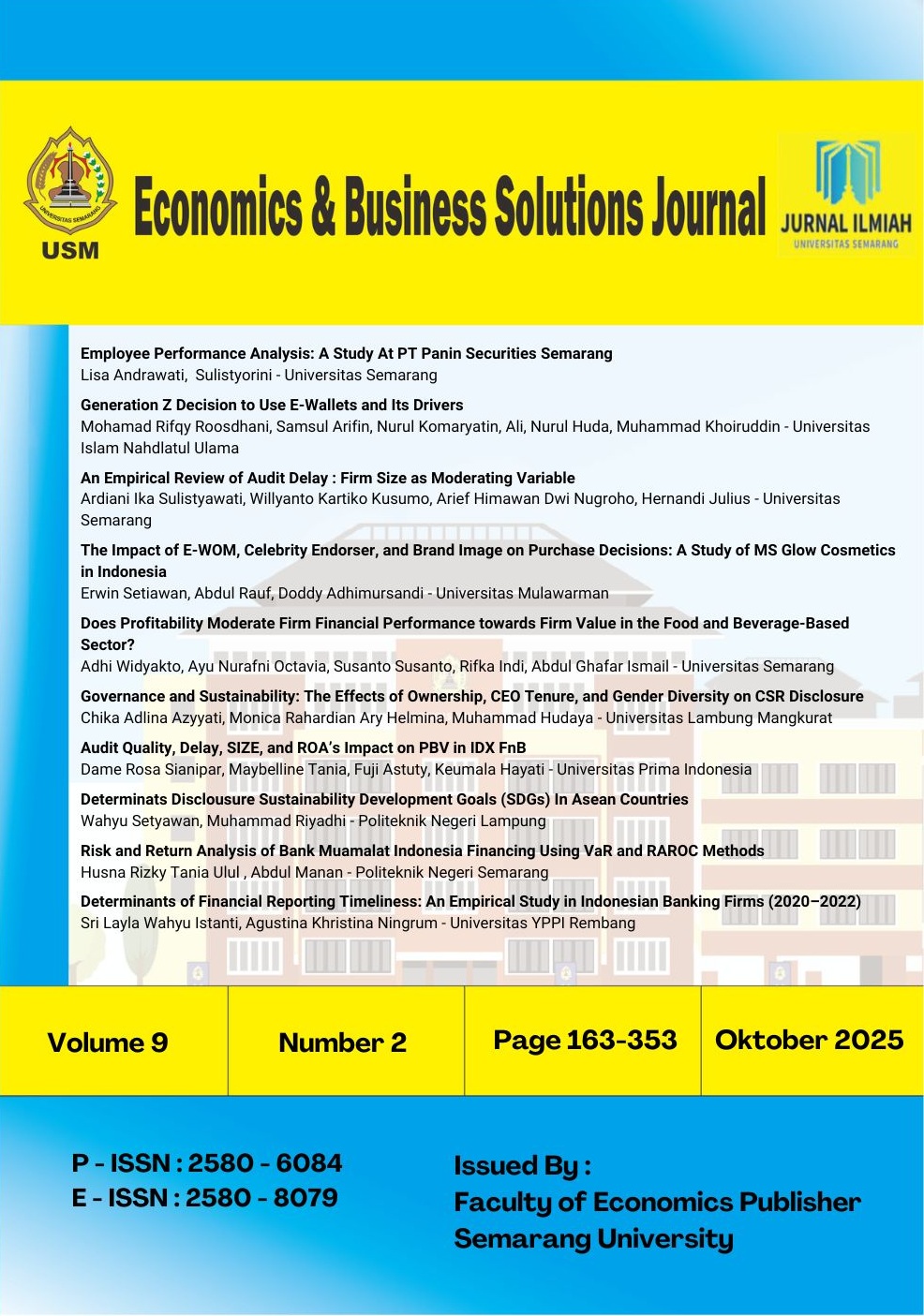
Governance and Sustainability: The Effects of Ownership, CEO Tenure, and Gender Diversity on CSR Disclosure 264 248
DOI:
https://doi.org/10.26623/ebsj.v9i2.12773Keywords:
Foreign ownership, CEO tenure, Ownership concentration, Board gender diversity, CSR disclosureAbstract
This study examines the influence of foreign ownership, CEO tenure, and ownership concentration on corporate social responsibility (CSR) disclosure, with board gender diversity as a moderating variable, in energy sector companies listed on the Indonesia Stock Exchange (IDX) during 2019–2023. Using a quantitative associative approach, data were collected from 47 purposively sampled companies. CSR disclosure was measured using the CSR Disclosure Index (CSRDI) based on the Global Reporting Initiative (GRI) Standards 2021, while ownership structure and managerial characteristics were measured through secondary data obtained from annual and sustainability reports. Data analysis employed Structural Equation Modeling (SEM) with WarpPLS 7.0 to test the research hypotheses. The results reveal that foreign ownership and ownership concentration have significant positive effects on CSR disclosure, whereas CEO tenure has a significant negative effect. Interestingly, board gender diversity does not significantly moderate the relationships between ownership structure, CEO tenure, and CSR disclosure. These findings contribute to the development of legitimacy theory and stakeholder theory by showing how ownership and leadership characteristics influence disclosure practices in emerging markets. Practically, the study provides implications for regulators and companies in Indonesia to strengthen sustainability governance, improve CSR reporting quality, and encourage meaningful board diversity
References
Agustina, L., & Sudibyo, Y. A. (2022). CEO Tenure and CSR Disclosure. Asian Journal of Business and Accounting, 15(1), 45–68.
Buertey, S. (2021). Ownership concentration and corporate social responsibility disclosure. Social Responsibility Journal, 17(2), 133–155.
Chau, G., & Gray, S. J. (2010). Family ownership, board independence and voluntary disclosure: Evidence from Hong Kong. Journal of International Accounting, Auditing and Taxation, 19(2), 93–109.
Gallego-Álvarez, I., García-Sánchez, I.-M., & Rodríguez-Domínguez, L. (2010). The influence of gender diversity on corporate performance. International Journal of Accounting & Information Management, 18(2), 105–132.
Giannarakis, G., Konteos, G., & Sariannidis, N. (2023). CSR disclosure and corporate characteristics in Greek firms. Corporate Social Responsibility and Environmental Management, 30(1), 1–12.
Gray, R., Owen, D., & Adams, C. (2001). Accounting and accountability: Changes and challenges in corporate social and environmental reporting. Prentice Hall.
Helmina, M. R. A., Ghozali, I., Isgiyarta, J., & Sutomo, I. (2019). How does reporting technology affect firm value? International Journal of Scientific and Technology Research, 8(7), 534–541.
Khan, A., Muttakin, M. B., & Siddiqui, J. (2013). Corporate governance and corporate social responsibility disclosures: Evidence from an emerging economy. Journal of Business Ethics, 114(2), 207–223.
Khan, H., Ali, M., & Uyar, A. (2022). Board structure and CSR disclosure: Evidence from South Asia. Sustainability Accounting, Management and Policy Journal, 13(4), 812–834.
Li, J., Wang, Y., & Wang, Y. (2021). CEO tenure and CSR performance: A dual-theoretical perspective. Corporate Social Responsibility and Environmental Management, 28(6), 1867–1882.
O'Donovan, G. (2002). Environmental disclosures in the annual report. Accounting, Auditing & Accountability Journal, 15(3), 344–371.
OJK. (2017). Peraturan Otoritas Jasa Keuangan No. 51/POJK.03/2017 tentang Penerapan Keuangan Berkelanjutan.
Post, C., Rahman, N., & Rubow, E. (2011). Green governance: Boards of directors’ composition and environmental corporate social responsibility. Business & Society, 50(1), 189–223.
Prado-Lorenzo, J. M., Gallego-Álvarez, I., & García-Sánchez, I. M. (2009). Stakeholder engagement and corporate social responsibility reporting: The ownership structure effect. Corporate Social Responsibility and Environmental Management, 16(2), 94–107.
Rao, K., & Tilt, C. (2016). Board composition and corporate social responsibility: The role of diversity, gender, strategy and decision-making. Journal of Business Ethics, 138(2), 327–347.
Reverte, C. (2009). Determinants of corporate social responsibility disclosure ratings by Spanish listed firms. Journal of Business Ethics, 88(2), 351–366.
Sari, R. D. P., Putri, H. A., & Yulianto, A. (2022). The Role of the Energy Sector in Environmental Policy in Indonesia. Jurnal Kebijakan Energi Nasional, 6(2), 101–115.
Setiawan, D., Phan, D. H. B., & Darmawan, S. (2021). Foreign ownership and CSR disclosure: Evidence from Indonesia. International Journal of Emerging Markets, 16(4), 693–711.
Shaheen, M., Nazir, M. S., & Saleem, A. (2021). Board gender diversity and CSR disclosure: Role of family ownership. Corporate Governance: The International Journal of Business in Society, 21(6), 1055–1072.
Tang, Z., Hull, C. E., & Rothenberg, S. (2015). How corporate social responsibility engagement strategy moderates the CSR–financial performance relationship. Journal of Management Studies, 49(7), 1274–1303.
Vu, T. T. H., & Buranatrakul, T. (2018). The legitimacy theory and corporate social responsibility disclosure in Vietnam. International Journal of Economics and Financial Issues, 8(3), 243–249.
Wang, Y., Song, L., & Yao, S. (2021). The impact of foreign institutional investors on CSR disclosure: Evidence from Chinese firms. Asia-Pacific Journal of Accounting & Economics, 28(4), 408–430.
Downloads
Published
Issue
Section
License
Copyright (c) 2025 Chika Adlina Azyyati, Monica Rahardian Ary Helmina; Muhammad Hudaya

This work is licensed under a Creative Commons Attribution 4.0 International License.
The journal holds the copyright for each article published with work licensed simultaneously under a Creative Commons Attribution 4.0 International License, which allows others to share the work with an acknowledgment of the authorship and early publication of the work in this journal.










 This work is licensed under a